
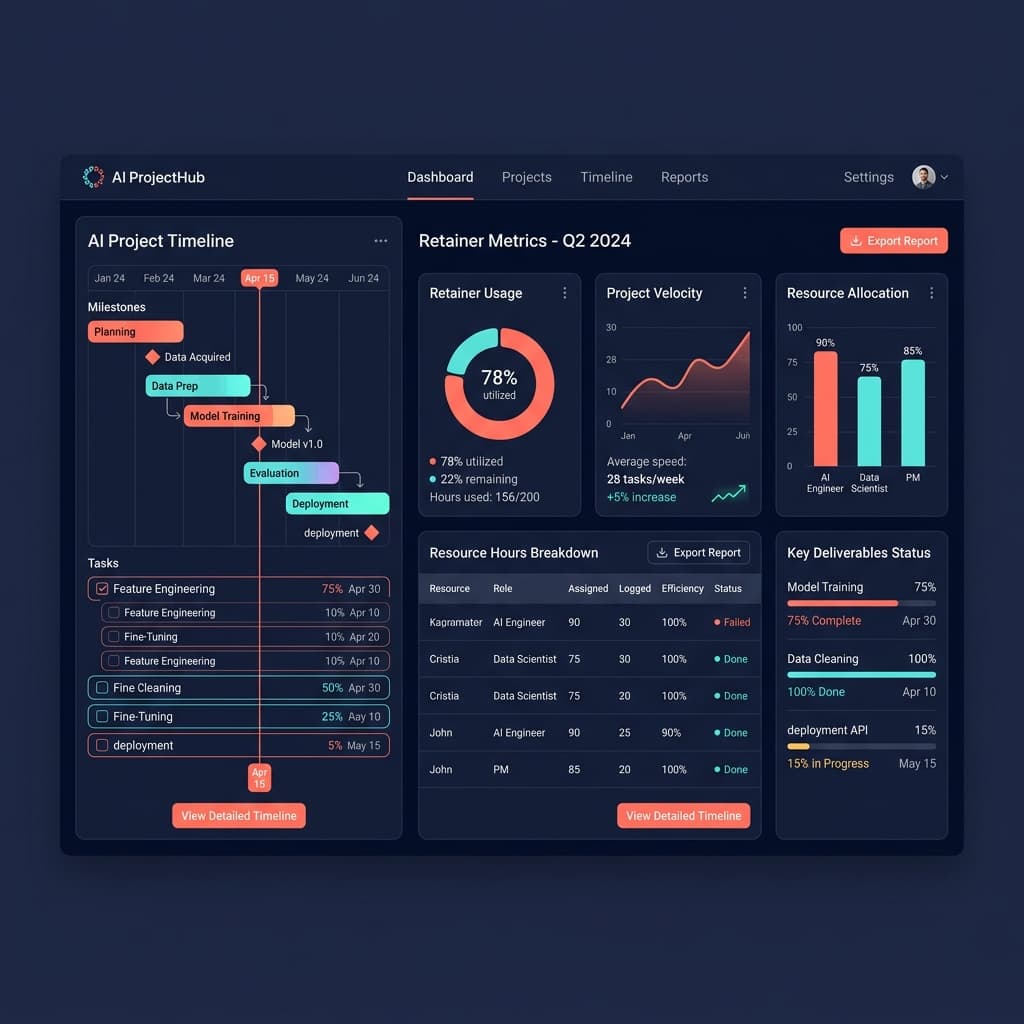
Most enterprise AI initiatives fail the exact moment the final invoice is paid. You scope a custom LLM integration, build the infrastructure, and sign off on the deliverables. Then the foundational models drift, the API endpoints deprecate, and your in-house engineering team inherits a system they did not architect and cannot maintain without specialist knowledge.
This is the standard outcome of AI project-based engagements run without a follow-on AI support contract. It is not a vendor problem. It is a structural mismatch between how fixed-scope contracts work and how AI systems actually behave in production.
Based on Seven Labs' client engagements across 50+ AI systems in the UAE and Pakistan, the AI retainer model consistently outperforms project-based engagements for customer-facing production AI. The exceptions are narrow and specific. This article explains why, and explains those exceptions honestly so you can make the right call for your organization.
Why Do Most Enterprise AI Projects Collapse After Deployment?
A fixed-scope AI project assumes that feature completion equals done. In generative AI, initial deployment is the baseline, not the finish line. The real engineering begins when actual users interact with models in production, and most project-based AI contracts close before this phase produces its first critical incident.
Six months after a standard AI agency delivers a working prototype, the model provider releases a cheaper, faster model with a different API contract. Anthropic updates its context window handling and deprecates the version your system relies on. Your fixed-scope AI project-based engagement covers neither migration nor the prompt template rewrites required to adapt to the new model. It does not cover adjusting the vector chunking strategy when your enterprise document volume doubles.
In regulated industries, the post-deployment window is precisely where compliance failures accumulate. An agency building under a fixed budget builds a functional wrapper around an API. They do not build the infrastructure required for zero-trust environments, PII redaction layers, or role-based access control enforcement at the vector database level. When new prompt injection techniques emerge six months after delivery, your static project codebase remains fully exposed.
According to KPMG's 2024 AI Outlook, 73% of AI implementations that reach initial deployment fail to achieve sustained business value within 18 months, with inadequate ongoing AI development and maintenance cited as the primary cause. [Source: KPMG, "Thriving in an AI World," 2024]
Your engineering team also receives a system they did not build, written in frameworks they may not fully know, with architecture decisions that were never documented. Maintaining it means either recruiting specialist MLOps engineers at significant cost or rebuilding substantial portions from scratch.
"Fixed-scope AI projects are essentially capturing a snapshot of a moving target. The model capabilities, the APIs, the best practices for prompt engineering: all of them shift on a quarterly basis. A contract that ends at deployment has already planned for obsolescence." -- Chip Huyen, Author, AI Engineering and ML Systems Design [Source: chip.huyen.com, 2025]
What Are the True Economics of an AI Maintenance Contract vs. In-House Hiring?
Recruiting senior AI engineers who understand RAG architecture, vector embeddings, LLMOps tooling, and production model deployment takes four to six months in most markets. When you find them, they command salaries 30 to 50% above standard senior engineer compensation in the same city. [Source: Levels.fyi AI Engineering Salary Report, 2025]
When you hire internal engineers to maintain a system built by an external AI agency, you inherit technical debt by default. The new engineer must reverse-engineer architecture decisions made under a fixed-scope budget, often without documentation, and under pressure from incidents that accumulate while they are still onboarding.
Based on Seven Labs' client engagements, in-house AI maintenance teams spend the first 60 to 90 days just mapping what they inherited before making a single meaningful improvement. When that engineer leaves, and in AI the churn rate is high, the entire institutional knowledge of your AI infrastructure exits with them.
A continuous LLMOps retainer eliminates the hiring cost and the churn risk simultaneously. Seven Labs operates as an extension of your infrastructure team. We document the architecture, maintain the pipelines, and ensure deployment continuity regardless of who is on your internal payroll. When one of our engineers rotates, the knowledge stays in our documentation layer, not in someone's memory.
The opportunity cost of in-house AI maintenance is also material. Your senior backend developers debugging RAG hallucination rates or vector recall degradation are not shipping core product features that drive revenue. Every sprint cycle spent on AI support work is a sprint cycle not allocated to the roadmap that justifies your growth projections.
Which AI Engagement Model Is Right for Your Situation?
The answer depends on whether your AI system is a living production asset or a bounded deliverable. An AI retainer suits customer-facing AI that must stay current with model upgrades, security patches, and changing user behavior. A fixed-scope project suits one-time deliverables like audits, proofs of concept, and migration reports. In-house hiring suits large enterprises managing ten or more simultaneous AI systems.
| Factor | AI Retainer | Project-Based | In-House Hire |
|---|---|---|---|
| Upfront cost | Monthly fee, no large capital outlay | Fixed project budget | Recruitment plus salary plus benefits |
| Time to first delivery | 2 to 4 weeks | 6 to 12 weeks | 4 to 6 months hiring plus build time |
| Ongoing AI development | Included in retainer scope | Requires new contract negotiation | Internal headcount responsibility |
| Model upgrades and migrations | Proactive and included | Not covered post-delivery | Internal engineering responsibility |
| Security patching | Active and continuous | Static after delivery date | Dependent on internal AI expertise |
| Knowledge retention | Retained in documentation layer | Leaves with vendor team | Vulnerable to engineer churn |
| Compliance adaptability | Continuous architecture reviews | Static at time of delivery | Depends on internal regulatory knowledge |
| Best for | Customer-facing production AI | POC, audit, or bounded deliverable | Large enterprise with 10+ AI systems |
The critical insight is that most organizations sit in the middle of this matrix. They have one to three AI systems in production, not ten. In-house hiring is not yet justified. And the AI partnership model they chose at build time, a fixed project, leaves them with no viable ongoing AI outsourcing model when the system needs its first major update.
Why Does Production AI Require Continuous LLMOps, Not a One-Time Deployment?
Production AI requires continuous LLMOps because machine learning models are non-deterministic. User behavior in production breaks initial assumptions about prompt injection, context limits, and data retrieval structures within weeks of launch. No staging environment fully predicts how real users interact with an AI system at scale.
Under an AI project-based engagement, your pipeline receives no updates until you negotiate a new contract. Under a continuous AI retainer, the team monitors pipeline latency in real time, swaps vector databases when your scaling requirements change, and patches vulnerabilities before a shadow AI incident becomes an enterprise data exposure.
When a new foundational model drops inference costs by 40%, a retainer allows you to route production traffic to it immediately. When your document volume doubles, the team adjusts the chunking strategy and re-embeds the vector store without interrupting user-facing service. These are routine tasks under an ongoing AI development contract. They are change-order negotiations under a project model.
Based on Seven Labs' client engagements, production AI environments require active engineering changes approximately every six to eight weeks to maintain performance benchmarks and security posture. A static project deployment cannot meet this cadence without creating accumulated technical debt that eventually forces a full rebuild.
Our RAG implementations have reduced client support resolution times by 40% at initial deployment. Maintaining that performance improvement over 12 months requires active monitoring, not a finished codebase.
"MLOps is not optional for production AI. The model is just the beginning. Data drift, prompt drift, dependency updates, security patches, and cost optimization all require ongoing engineering attention. Treating AI deployment like shipping a static web app is how you end up with a large monthly API bill and no one who knows why." -- Josh Tobin, Co-Founder, Gantry AI [Source: Gantry Blog, 2025]
Does an AI Agency Retainer Create Vendor Lock-In for Your Infrastructure?
An AI agency retainer creates less lock-in than a project-based engagement when the project is delivered undocumented. You own the code legally but depend on the original vendor to interpret it the moment it breaks. A well-structured managed AI services relationship is the opposite.
A properly scoped AI support contract operates on full transparency. Seven Labs builds on open-source frameworks where possible and standard enterprise infrastructure. Your internal team retains full visibility into the GitHub repository, the CI/CD pipelines, and the monitoring dashboards from day one. The retainer exists to execute the ongoing labor of maintaining AI infrastructure, not to hold your architecture in a proprietary black box.
The AI partnership model we structure is designed for clean exits. If you decide to transition AI maintenance in-house after 18 months, the system is fully documented and running on standard enterprise tooling. We support a handover period where your internal team shadows our engineers on the live system before assuming ownership. Clean exits are not a risk for us. They are a stated goal because they are why UAE clients return for subsequent projects.
When Does a Fixed-Scope AI Project-Based Engagement Actually Make Sense?
Fixed-scope AI projects are the right choice for bounded deliverables where the output is a document or a validated prototype, not a living system. Knowing when to use a project contract rather than a retainer is as important as knowing when to use a retainer.
A fixed-scope AI project-based engagement works well for initial proof-of-concept validation, where the goal is a binary go/no-go decision on a business hypothesis before committing infrastructure resources. It works for security audits on existing LLM endpoints, where the deliverable is a written risk assessment and remediation plan. It works for one-time data pipeline migrations where the output is a fully transferred and tested system with no ongoing dependency on the migrating vendor.
The signal that a project contract is wrong for your situation is whether the system requires interaction with real users after delivery. Customer-facing AI requires ongoing AI development because user behavior is unpredictable and model behavior shifts. Internal tooling with a fixed use case and a stable dataset may sustain longer without active maintenance. Customer-facing systems almost never do.
For everything else, treating production AI as a one-off project is effectively an AI outsourcing model built around planned obsolescence. You are locking your enterprise into the technical debt of a static snapshot of AI technology, and you will pay to rebuild it within 18 months.
How Does Seven Labs Structure a Managed AI Services Retainer?
We define strict SLAs for pipeline uptime, hallucination monitoring thresholds, and infrastructure scaling parameters at the start of every retainer engagement. Your internal developers own the product roadmap and the user experience. We own the underlying AI infrastructure, the model upgrades, and the deployment complexity.
Based on Seven Labs' client engagements, we delivered a fully functional AI agent in 18 days for one UAE-based client who had been rebuilding the same system quarterly under a rotating series of fixed-scope projects. The retainer structure eliminated the rebuild cycle.
In the RE/MAX Dubai automation engagement, the initial architecture was the starting line, not the finish line. Real estate data in the UAE is structurally inconsistent. Listing formats change, external government APIs break without notice, and agent routing logic requires ongoing recalibration based on market velocity. A fixed-bid AI project would have left the client with a brittle pipeline that failed the first time a third-party property portal changed its data schema.
The retainer structure absorbed the maintenance burden completely. When a new foundational model reduced inference costs by 50%, we routed the production traffic to it without a new contract negotiation and without reallocating any of the client's internal sprint capacity.
Explore our AI platforms services for current retainer structures and how we define success metrics at the engagement level.
Frequently Asked Questions
How do you prevent scope creep on an ongoing AI development retainer?
We define the retainer scope explicitly at the outset: which systems are covered, what response SLAs apply, and which categories of work require a separate project contract. Model updates, security patching, and performance monitoring are included. New feature development is a separate scope. Clear written boundaries prevent scope expansion without limiting incident response capacity.
What happens if we want to transition AI maintenance in-house after 12 months?
We document the architecture from the first sprint and maintain that documentation as the system evolves. A transition plan is available at any point. We support a handover period where your internal team shadows our engineers on the live system before taking ownership. The AI support contract goal is a clean transition, not a dependency relationship.
Can we start with a project-based engagement and convert to an AI retainer?
Yes. The most common AI partnership model is a fixed-scope proof of concept, followed by a pilot program, then a production retainer. The POC validates the business hypothesis. The retainer handles ongoing managed AI services after validation. This sequence avoids committing retainer resources to an unconfirmed use case and is the path Seven Labs recommends for first-time AI engagements.
How does the retainer handle compliance changes in Gulf markets?
Our team monitors regulatory guidance from central banks in the UAE and Saudi Arabia as part of active retainer work. When data residency requirements or AI governance mandates change, we assess the architectural impact and propose updates within the retainer scope. Compliance under a managed AI services contract is an ongoing process, not a one-time certification milestone.
Do not let your enterprise AI strategy stall on the day of deployment. Production AI requires continuous engineering, active monitoring, and an AI maintenance contract structured to evolve alongside the models and regulations it depends on.
If you are evaluating AI partners in the UAE or Pakistan, book a 30-minute scoping call with Seven Labs: https://calendly.com/sevenlabsolutions/30min