
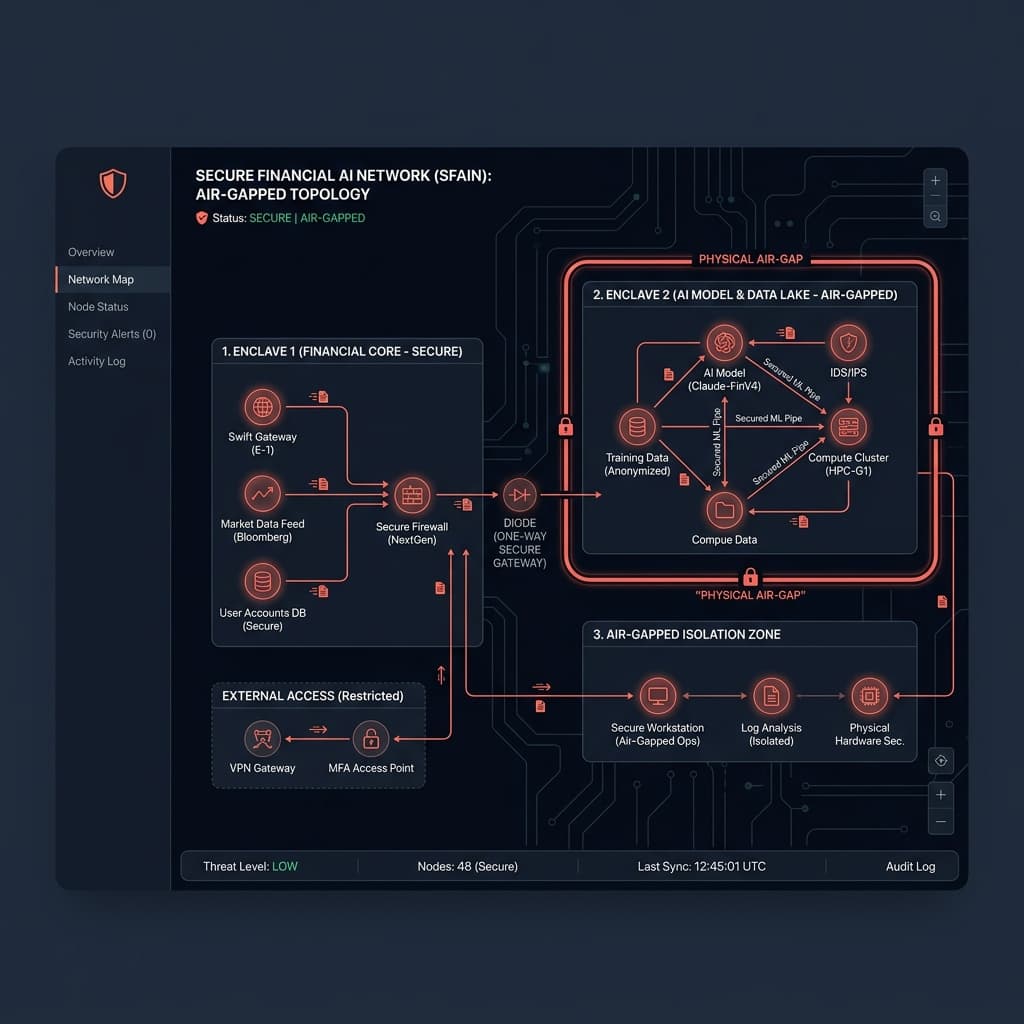
Financial engineering teams face a strict binary: modernize compliance and fraud detection with Large Language Models, or maintain data residency by keeping networks entirely isolated. You cannot pipe sensitive customer PII to an external API without triggering immediate compliance breach risks. Central bank mandates in the Gulf and global SOC 2 requirements explicitly prohibit this kind of data exposure.
The solution is air-gapped AI deployed inside the institution's own perimeter. This requires severing all external dependencies and architecting systems that operate with zero external network connectivity. Based on Seven Labs' security deployments across 50+ engagements, air-gapped deployment failures trace back to one root cause: teams treat it as a standard cloud deployment with the internet turned off. It is not.
What Is the Real Compliance Risk of Sending Financial Data to External AI APIs?
Routing unmasked PII, KYC documents, or transaction histories to external LLM APIs is a direct compliance violation under FINRA AI guidelines, SEC AI compliance frameworks, and PCI-DSS AI controls. Fines in regulated Gulf markets operate as a percentage of global revenue. A single incident routinely exceeds the full cost of an on-premise LLM deployment. [Source: Gulf AI Governance Conference, 2025]
The failure mode that regulators care most about is not an external breach. The Shadow AI problem is more common and harder to detect. Engineers frustrated by strict network restrictions find workarounds to access cloud models. A developer accidentally logs sensitive transaction data to a cloud-hosted observability tool. A debugging script makes a hidden call to an external API endpoint. Another developer hardcodes a commercial LLM key into an orchestration layer that runs in production.
None of these appear in security monitoring as attacks. They appear as normal internal traffic. The only effective countermeasure is providing a production-grade offline AI financial alternative that is fast and reliable enough that engineers choose it over shadow channels. If the sovereign AI system is slow or unreliable, shadow usage becomes inevitable.
"Financial institutions in the Gulf operate under some of the strictest data sovereignty requirements globally. The assumption that cloud AI providers can satisfy these requirements through contractual assurances is not technically defensible. Data must remain on-premise at the infrastructure level, not just the policy level." -- Dr. Saqr Al-Moataz, Former CTO, UAE Federal Government Digital Authority [Source: Gulf AI Governance Conference, 2025]
How Do You Architect an Air-Gapped AI System That Satisfies FINRA, SEC, and PCI-DSS Requirements?
A compliant isolated AI environment for financial services requires four pre-staged tiers, all deployed before the network boundary closes. Standard cloud-native architectures assume constant connectivity to package registries and model hosting services. Air-gapped network deployment inverts every one of those assumptions. [Source: NIST SP 800-204C, 2025]
Based on Seven Labs' security deployments, we structure offline AI financial infrastructure into these tiers:
Tier 1: Offline Model Registry. Model weights in safetensor format and their tokenizers must be downloaded externally, scanned for supply chain attacks, and transferred to an internal artifact registry. Tokenizers often attempt to pull configuration files at runtime via HTTP. These calls must be intercepted and redirected to local file paths before the system reaches production.
Tier 2: Inference Engine. Managed cloud endpoints are unavailable in an isolated AI environment. We deploy optimized local inference servers, specifically vLLM or Text Generation Inference (TGI), configured strictly for offline execution on dedicated bare-metal GPU clusters inside the corporate firewall. Configuration must explicitly disable all telemetry, heartbeat calls, and update checks.
Tier 3: Local Vector Store. For banking AI deployment using RAG pipelines, vector databases such as Qdrant or Milvus must be deployed locally. We strip these containers of all default telemetry and analytics configurations before deployment. Default container configurations for popular open-source vector databases frequently include analytics calls that violate air-gap requirements without explicit configuration to disable them.
Tier 4: Air-Gapped Telemetry. Observability cannot be outsourced to external SaaS platforms when no external connectivity is permitted. We deploy internal Prometheus and Grafana stacks to monitor GPU utilization, token generation latency, and memory spikes. All alerting routes through internal infrastructure with no outbound network dependency.
Air-Gapped vs. Private Cloud vs. VPC-Isolated vs. Public Cloud: Which Model Fits Regulated Finance?
For financial services AI, the right deployment model depends on your regulatory jurisdiction, data classification, and tolerance for residual external dependency. Based on Seven Labs' security deployments in regulated Gulf markets, sovereign AI on air-gapped infrastructure is the only model that satisfies the strictest central bank mandates without relying on vendor contractual controls.
| Option | Data Isolation | Compliance | Cost | Latency | Update Complexity |
|---|---|---|---|---|---|
| Air-Gapped On-Premise | Absolute: zero external network path | Highest: satisfies CBUAE, SAMA, FINRA, PCI-DSS AI | High upfront CapEx; no recurring API fees | Lowest for local users | High: manual artifact promotion required |
| Private Cloud (Dedicated Tenant) | Strong: contractual and technical controls | Medium: depends on provider certifications | Medium: managed service fees | Low to medium | Medium: shared responsibility model |
| VPC-Isolated (Cloud) | Partial: control plane often external | Lower: metadata flows to cloud provider | Low upfront; usage-based billing | Medium; varies by region | Low: provider-managed patching |
| Public Cloud AI API | None: data leaves perimeter entirely | None for regulated PII workloads | Lowest upfront; high at scale | Lowest absolute | None required |
The VPC-isolated model is frequently misrepresented as equivalent to air-gapping. It is not. Management plane traffic, control plane telemetry, and provider audit logs all flow externally in a standard VPC deployment. For SEC AI compliance and FINRA AI obligations that require complete data residency financial controls, VPC isolation is insufficient.
What Does It Actually Cost to Deploy an On-Premise LLM in a Banking Environment?
The upfront hardware cost for a production banking AI deployment is significant, but the compliance cost of the alternative is higher. A pair of A100 80GB GPUs with a dedicated high-bandwidth interconnect, required for a 13-70B parameter on-premise LLM serving 50 concurrent users, costs approximately $60,000-$120,000 in hardware depending on procurement timing. [Source: NVIDIA Enterprise Pricing, 2026]
The hidden cost that most internal teams miss is MLOps engineering time. Air-gapped financial AI does not patch itself, scale itself, or update its dependencies automatically. Every capacity decision must be made upfront. A model that fits on a single GPU at 8-bit quantization may require two cards at 4-bit if your maximum context window is 64K tokens. Errors in capacity planning result in either degraded performance under load or expensive emergency procurement with multi-week delivery lead times.
Based on Seven Labs' security deployments, teams that attempt air-gapped AI builds internally without prior experience average four to six months before stalling. The most common stall point is discovering that a critical Python dependency has a transitive dependency on a package hosted on an external CDN, mid-deployment, with no offline resolution path. A scoping call with Seven Labs at the architecture phase typically eliminates this class of failure entirely.
We implement continuous batching protocols that improve effective throughput by 200-400% compared to naive single-request inference. [Source: vLLM Benchmarks, 2025] This is the critical factor that makes on-premise performance competitive with external APIs and removes the incentive for engineering teams to route workloads to shadow cloud services.
"Building AI in a regulated financial environment is not a technology problem. It is an architecture discipline problem. The technology exists. The challenge is designing the system so that every component fails safely, with no external dependency that can become a compliance liability." -- Bruce Schneier, Security Technologist and Author, Schneier on Security [Source: Schneier on Security, 2025]
How Do You Keep an Isolated AI Environment Patched Without Breaking the Air Gap?
Deploying the model is roughly 20% of the total lifecycle cost. The real engineering challenge is maintaining the isolated AI environment 18 months later. Air-gapped systems suffer from dependency drift: libraries fall behind, CVEs are published against components that cannot be patched over the internet, and new model weights with improved accuracy cannot be downloaded directly. [Source: CISA Air-Gap Security Advisory, 2025]
Based on Seven Labs' security deployments, we implement a defined offline artifact promotion pipeline. Updates are pulled from public registries into an internet-facing DMZ staging environment. There, they are subjected to static analysis, malware scanning, and artifact signing. Approved artifacts are then packaged as signed OCI-compliant container images and moved across the secure boundary via physical media or strictly controlled cross-domain solutions before reaching the air-gapped environment.
When our VAPT penetration testing team identified 11 critical vulnerabilities across a client's AI inference stack, four of them existed because the team had no defined process for promoting security patches across the air gap. The vulnerabilities had been disclosed publicly for 60-90 days before the engagement. A defined artifact promotion process with automated CVE scanning in the DMZ layer would have closed all four within the standard 30-day remediation window.
For banking AI deployment that requires ongoing compliance assurance, the artifact promotion pipeline is not optional. It is the mechanism by which data residency financial controls remain enforceable over the system's operational lifetime rather than only at go-live.
Explore our AI platforms services to understand how Seven Labs structures ongoing support for on-premise financial AI deployments, and our VAPT penetration testing protocols for validating isolated AI environments before go-live.
Frequently Asked Questions
Can we run a production-grade on-premise LLM that satisfies PCI-DSS AI requirements and competes with external API performance?
Yes, with appropriate hardware and configuration. A 13-70B parameter model at 4-bit AWQ quantization on dual A100 80GB GPUs with continuous batching produces inference speeds that are competitive with external APIs for most financial services AI workloads. PCI-DSS AI compliance requires zero external data flows, which this architecture satisfies completely. Hardware sizing must be validated against your specific peak concurrent user count before procurement. [Source: Seven Labs deployment benchmarks, 2025]
How does Seven Labs handle FINRA AI and SEC AI compliance validation for air-gapped deployments?
Based on Seven Labs' security deployments, we conduct formal pre-go-live VAPT testing that validates the isolated AI environment against prompt injection, data exfiltration via model outputs, and covert channel attacks. We produce audit-ready documentation of all network boundaries and data flows, which satisfies the technical evidence requirements for FINRA AI and SEC AI compliance reviews. Our VAPT team identified 11 critical vulnerabilities in a recent financial AI engagement that the client's internal team had not detected.
What is the realistic timeline for deploying a sovereign AI system in a regulated financial institution?
Based on Seven Labs' security deployments, a complete air-gapped AI deployment from architecture scoping to production validation takes 10-16 weeks for a greenfield environment. Institutions with existing GPU infrastructure and mature change management processes can reach the lower end. The longest phases are dependency staging and pre-go-live VAPT validation. Teams attempting internal builds without prior air-gap experience typically require 4-6 months before reaching the same stage.
Does on-premise LLM deployment satisfy CBUAE and SAMA data residency financial requirements without additional contractual controls?
Deployment within the institution's own data centers satisfies the technical requirements of Central Bank of UAE and Saudi Arabian Monetary Authority data residency mandates, provided no telemetry or operational data flows to external systems. Contractual data processing agreements with cloud providers are not sufficient on their own for these jurisdictions. The deployment must be validated through a formal technical audit confirming zero external data paths. [Source: CBUAE AI Governance Framework, 2025]
Building offline AI infrastructure for financial services requires alignment between security, compliance, and systems engineering from day one. Internal teams that treat air-gapped network deployment as a standard cloud project with the internet turned off consistently reach the same stall points.
If you are evaluating air-gapped AI or banking AI deployment partners in the UAE or Pakistan, book a 30-minute scoping call with Seven Labs: Contact Seven Labs