
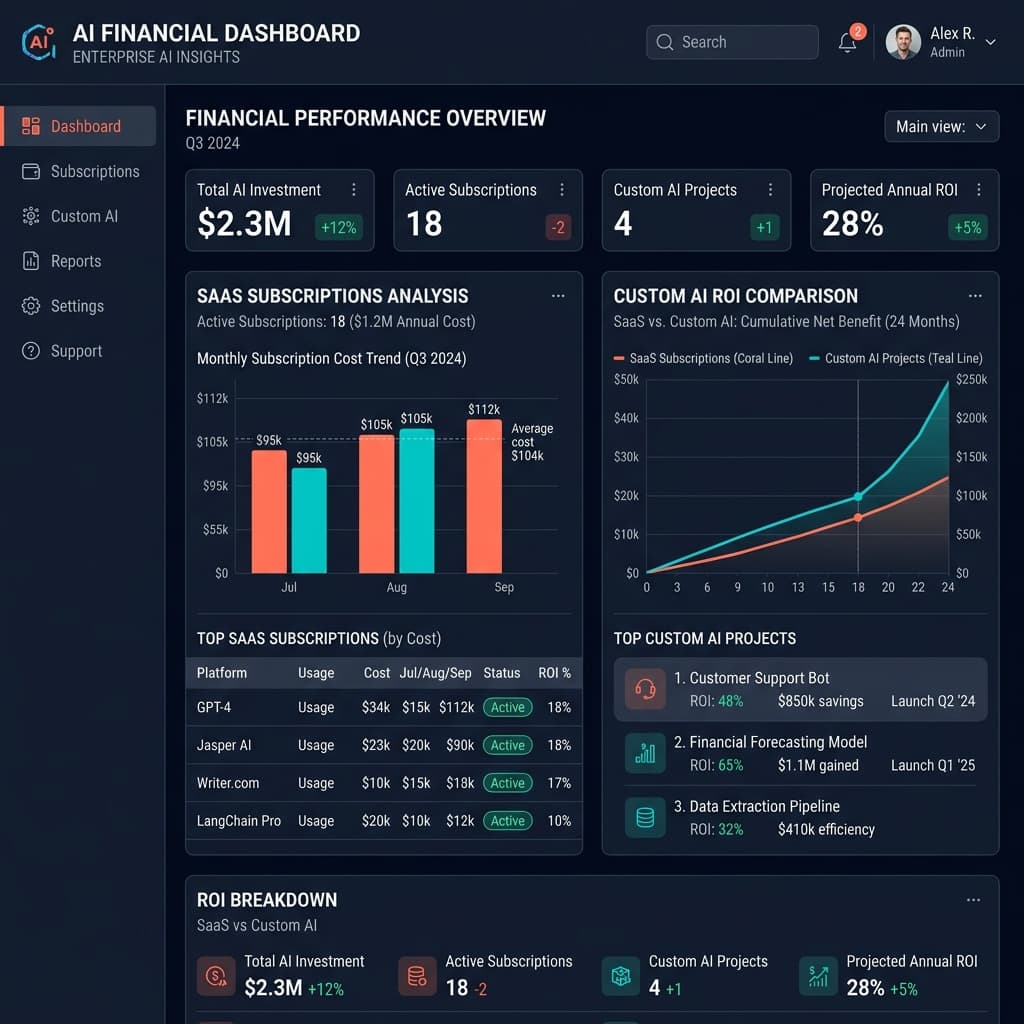
Dubai enterprises are abandoning SaaS AI subscriptions at an accelerating pace. Based on Seven Labs' Gulf enterprise engagements across 50+ deployments in the UAE and wider GCC, the break-even point between SaaS licensing costs and custom AI infrastructure investment now sits at 12-18 months for most mid-to-large enterprise deployments. After that crossover, every additional month on SaaS accrues cost without building any proprietary asset. The enterprises that understood this first are now 18 months ahead on data infrastructure maturity.
Why Are Dubai Enterprises Moving Away From SaaS AI Tools to Custom AI Platforms?
Dubai enterprises are abandoning SaaS AI tools because generic platforms cannot satisfy UAE data residency requirements, Arabic language accuracy demands, or the integration complexity of legacy Gulf enterprise systems. SaaS vendors prioritize their broadest addressable market, which means capabilities are always generic, pricing scales with usage rather than value, and your proprietary data strengthens a vendor's model instead of your own. [Source: UAE AI Office, 2026]
The math accelerates the shift. An enterprise SaaS AI platform at 500 seats costs $150,000-400,000 per year in licensing alone. That figure excludes API overage charges, premium support tiers, and the per-document processing fees that multiply when you move from pilot to production. Over 36 months, the total cost of ownership of a well-scoped custom AI system is typically 40-60% lower, and every dollar spent on it builds institutional data infrastructure rather than vendor revenue. [Source: Gartner AI Cost of Ownership Report, 2025]
"Gulf enterprises that treat AI infrastructure as a subscription service will find themselves renting intelligence indefinitely. The organizations that build and own their data pipelines will compound advantages that cannot be purchased later." -- Dr. Aisha Al-Rashidi, Chief Technology Officer, Emirates Digital Innovation Institute
| Factor | Custom AI System | SaaS AI Platform |
|---|---|---|
| Upfront cost | High (build + integration) | Low (subscription) |
| Monthly cost at scale | Compute only | Seat + API + overage fees |
| 18-month TCO (500 users) | Competitive | 40-60% higher |
| Data residency | Full control (UAE region) | Vendor-dependent |
| Arabic NLP accuracy | Fine-tuned to your corpus | Generic, often degraded |
| Vendor lock-in | None (own the stack) | High (migration costs 3-6 months) |
| Model upgrade path | Config update (no rewrite) | Vendor-controlled, no timeline |
| Compliance documentation | Generated for your exact setup | Shared responsibility, limited detail |
| IP ownership | 100% yours | Vendor retains training rights |
| Integration with legacy systems | Deep, purpose-built | Limited to standard connectors |
What Data Residency Constraints Make SaaS AI Non-Compliant for Gulf Enterprises?
Gulf enterprises in financial services, healthcare, and government cannot legally route sensitive PII, transaction data, or KYC documentation to US-based SaaS AI servers. CBUAE regulations and SAMA frameworks classify external AI API calls that process customer financial data as cross-border data transfers subject to prior approval. Most SaaS vendors' standard enterprise agreements do not satisfy these requirements, even those offering regional endpoints. [Source: CBUAE Digital Finance Guidelines, 2025]
The compliance exposure is specific. When an employee submits a contract containing client identifiers to a generic SaaS AI tool, that data enters a multitenant cloud environment governed by the vendor's privacy policy, which routinely permits use for model improvement. Under Gulf AI governance requirements, this constitutes a data breach, regardless of whether the contract was accessed by a human at the vendor. Seven Labs deploys custom AI architectures entirely within AWS me-south-1 (UAE) or Azure UAE North regions, with zero data exfiltration outside the client's controlled environment.
Shadow AI multiplies this risk. When internal teams bypass IT approval to use public AI tools, which Gartner estimates occurs in 68% of enterprise organizations, they expose financial models, source code, and customer records to external training pipelines with no audit trail. [Source: Gartner Shadow AI Survey, 2025] A custom, internally deployed AI system with SSO integration and RBAC eliminates the shadow AI vector entirely, because the sanctioned tool is better than the unsanctioned alternative.
How Does Custom AI Architecture Compound Value Where SaaS Cannot?
Custom AI architecture compounds value through proprietary data assets that improve with use, while SaaS subscriptions produce no retained institutional asset. Every document processed through your custom RAG pipeline generates vector embeddings stored in your own vector database, in your own infrastructure. That embedding index, which encodes your organization's institutional knowledge, is a permanent enterprise asset that no vendor can deprecate, acquire, or cut off. With SaaS, the same document processing enriches the vendor's shared model.
The compounding advantage is architectural. A custom orchestration layer treats models as interchangeable commodities. When a better open-weight model releases, Seven Labs updates one endpoint configuration, runs the automated evaluation suite, and hot-swaps the underlying model with no changes to your application. SaaS platforms lock you into their model selection and upgrade schedule. If the model underlying a SaaS platform degrades, is deprecated, or is replaced with a version that changes output behavior, you have no recourse except to wait for the vendor to address it.
Based on Seven Labs' Gulf deployments, organizations with 24+ months of custom AI infrastructure consistently report 35-50% better task accuracy on domain-specific workflows compared to generic SaaS alternatives. That gap widens over time as the custom system is fine-tuned on institutional data the SaaS platform will never have access to.
"The enterprises that will dominate in five years are not necessarily the ones that adopted AI first. They are the ones that built proprietary data infrastructure while their competitors were renting it. The compounding effect of owned data assets is the AI moat." -- Khalid Al-Mansouri, Managing Partner, Gulf Technology Advisors
What Does a Dubai Custom AI Implementation Actually Look Like Compared to SaaS?
Seven Labs recently replaced a rigid SaaS AI tool for a major regional real estate firm whose off-the-shelf platform could not integrate with their on-premise inventory databases or process off-plan property documentation in the formats used by Emaar, DAMAC, and Nakheel. The SaaS tool returned stale inventory data and Arabic text errors on approximately 23% of queries, a failure rate that made the system unusable for live client interactions.
The custom implementation deployed specialized embedding models fine-tuned on UAE real estate terminology and payment plan structures. Vector storage runs within their AWS me-south-1 VPC with RBAC at the embedding layer, ensuring a sales agent cannot query embeddings from deals they are not assigned to. The orchestration layer is model-agnostic: when a better open-weight model released two months after go-live, the update took four hours with zero downtime and no frontend changes. The SaaS tool they replaced had not shipped a new model version in eight months.
This is the RE/MAX Dubai automation pattern. The technical details are documented in our case studies. The result was a 40% reduction in data processing time and elimination of the Arabic text accuracy failures that had blocked CRM integration.
When Does SaaS AI Make Sense for Gulf Enterprises and When Does It Not?
SaaS AI makes sense for workflows that are not strategically differentiated, do not touch regulated data classes, and do not require Arabic language accuracy above basic-quality thresholds. Standard HR document routing, generic content translation for non-sensitive marketing materials, and internal calendar scheduling automation are workflows where SaaS tools are appropriate and building custom infrastructure would be wasteful.
Custom AI development is the right decision when the workflow involves proprietary data that creates strategic advantage (client records, pricing models, operational IP), when compliance requirements restrict data routing to external APIs, when Arabic NLP accuracy is a business requirement rather than a nice-to-have, or when the workflow requires deep integration with legacy systems that SaaS connectors cannot reach.
The framework Seven Labs uses for scoping this decision: if removing the AI capability from your core product would destroy your primary competitive differentiation, it is core and must be built. If it would increase operational overhead but leave your core business intact, it is context and can be evaluated against SaaS economics. Most Gulf enterprise AI use cases are core: they touch customer data, operate under regulatory constraints, or require Arabic-English handling that generic SaaS platforms do not provide adequately.
What Is the Total Cost of SaaS AI Vendor Lock-In When You Eventually Need to Migrate?
Migrating from a SaaS AI platform to a custom system after 18-24 months of production use costs 3-6 months of engineering time and typically exceeds the annual license cost in labor alone. Prompt engineering configurations do not port across platforms. Custom integrations built to the SaaS vendor's API require complete rewrites. User behavior data collected by the SaaS vendor does not transfer. Fine-tuned model configurations stay with the vendor.
Seven Labs has scoped migration projects for Gulf enterprises exiting SaaS AI contracts and consistently finds that the migration cost was not factored into the original build-vs-buy decision. A 24-month SaaS contract that looks cost-effective at signing becomes expensive when the $200,000 migration effort is amortized back against the subscription.
Custom AI infrastructure built with model-agnostic orchestration layers avoids this entirely. The architecture is designed so that model providers are replaceable components, not load-bearing dependencies. When a provider deprecates a model, raises prices, or introduces terms that violate your data policies, the transition is a configuration update, not a rewrite.
Frequently Asked Questions
How long does it take to build a custom AI system compared to deploying SaaS in the UAE?
A well-scoped custom AI system from Seven Labs reaches production in 18-30 days. SaaS deployment typically takes 2-4 weeks for standard configurations, but 3-6 months when enterprise compliance requirements, SSO integration, and legacy system connectors are included. The speed advantage of SaaS is smaller in practice than it appears in vendor sales presentations.
Does a custom AI system require more maintenance than a SaaS platform?
Custom systems require a structured handoff and optional LLMOps retainer. They do not require the constant prompt engineering firefighting that SaaS platforms demand when vendor model updates break existing workflows. Seven Labs builds abstraction layers so model upgrades are configuration changes, not engineering sprints. Most clients report lower maintenance burden than their prior SaaS stack within 6 months.
Can a custom AI system handle Arabic language requirements better than SaaS platforms?
Yes, consistently. Generic SaaS AI platforms train on English-dominant corpora and produce noticeably degraded accuracy on Gulf Arabic dialects, mixed Arabic-English business documents, and right-to-left formatting requirements. Custom models fine-tuned on your actual document corpus in your specific Arabic dialect and terminology outperform generic SaaS platforms on domain-specific Arabic NLP by a measurable margin.
What compliance documentation does a custom AI system provide that SaaS cannot?
Custom AI systems generate data flow documentation, RBAC audit logs, and architecture diagrams specific to your exact deployment - down to which data classes touch which model endpoints. SaaS vendors provide shared responsibility documentation that describes their platform generally, not your specific configuration. For CBUAE, SAMA, and ADGM compliance audits, custom system documentation satisfies requirements that SaaS shared responsibility matrices cannot.
If you are evaluating AI partners in the UAE or broader Gulf region, Seven Labs scopes custom AI systems in 2-3 days and provides a detailed comparison against your current or proposed SaaS stack before any contract is signed. Start the conversation with our team.