
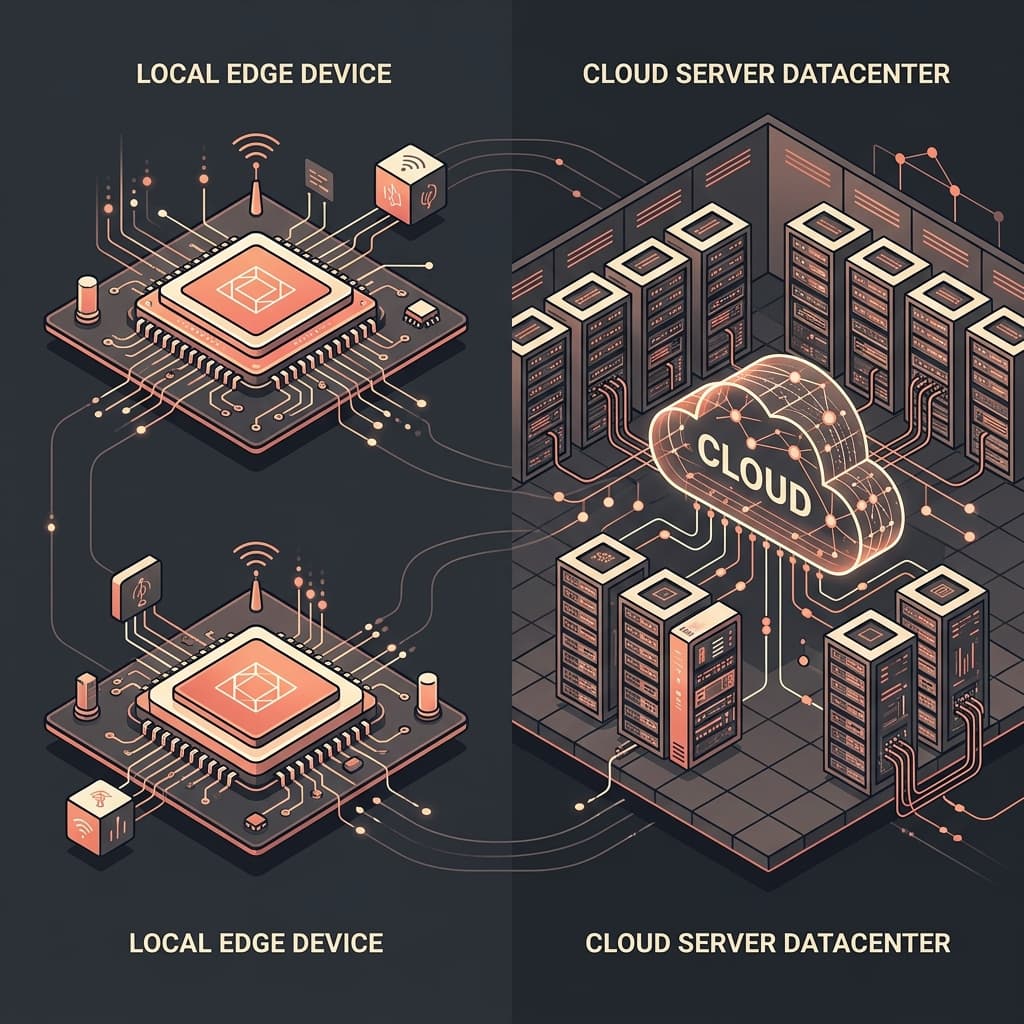
Edge AI vs Cloud AI: Choosing the Right Architecture for Enterprise Systems
The wrong inference location is the most expensive architectural decision in AI systems. Based on Seven Labs' AI deployments across 50+ production engagements, this single choice drives more downstream engineering cost than any other infrastructure decision. Deploy to the cloud when your latency requirements demand edge inference, and you pay in degraded user experience indefinitely. Deploy to the edge when your use case requires large-model reasoning, and you ship a product that fails in production before the second sprint review.
This guide covers the technical trade-offs with real numbers so architects and engineering leads can make the right call before writing a line of application code.
What Is the Real Latency Difference Between Edge AI and Cloud AI?
Edge AI inference runs at 12ms-50ms for standard classification and generation tasks. Cloud AI inference runs at 150ms-600ms once network roundtrip, queue delay, and time-to-first-token are included. The gap is structural: on-device inference eliminates network overhead entirely, not just partially [Source: Nvidia, 2025].
Cloud latency breaks into distinct components. Network roundtrip adds 50ms-200ms depending on geography and TLS negotiation overhead. Enterprise networks with proxy layers and SSL inspection add another 150ms-400ms before the model receives the first token [Source: Cloudflare, 2025]. Queue delay under multi-tenant server load is variable and unpredictable at peak hours. Time-to-first-token for large models ranges from 100ms to 600ms. Generation time scales with output length.
Edge AI eliminates the network entirely. A Llama-3-8B model quantized to INT4 runs at 33 tokens per second on Apple Silicon with 150GB/s memory bandwidth, and at under 9 tokens per second on a budget x86 workstation with standard DDR4 memory. The hardware deployed to determines user experience at the edge tier, not the architecture tier itself.
For IoT AI and embedded AI applications where user actions require immediate visual or audio feedback, the latency difference is decisive. A 150ms cloud roundtrip is acceptable for document summarization. It is not acceptable for real-time machine vision on a manufacturing line, fog computing applications coordinating across distributed edge nodes, or voice interfaces where input is continuous and pauses are perceptible.
How Does Model Quantization Make Edge Deployment Practical on Real Hardware?
Model quantization converts FP16 weights to INT8 or INT4, cutting memory requirements by 2x to 4x with less than 3% accuracy degradation on standard tasks [Source: Meta AI Research, 2025]. Without quantization, most capable open-source models cannot run on edge hardware at production throughput.
An 8B parameter model at FP16 precision requires 16GB of RAM. At INT4, the same model requires 4.5GB. That difference determines whether on-device inference runs on standard enterprise laptops or requires dedicated GPU workstations. In Seven Labs' AI deployments, a 4-bit quantized Llama-3-8B retains approximately 97% of its FP16 reasoning quality on classification and summarization tasks while running on hardware available in any office environment.
The main quantization runtimes each target different hardware. ONNX provides cross-platform edge deployment with hardware-specific execution providers for CPU, GPU, and NPU targets. TensorFlow Lite is the standard for mobile and embedded AI on Android devices and microcontrollers. TensorRT from Nvidia delivers maximum throughput on Nvidia edge hardware including Jetson modules used in industrial edge computing. For CPU-first and Apple Silicon targets, llama.cpp remains the most flexible option for edge deployment without GPU dependency.
Choosing the wrong inference engine for the target hardware costs 2x to 4x in throughput on identical silicon. ONNX Runtime with the OpenVINO execution provider on an Intel Core Ultra NPU significantly outperforms llama.cpp on the same chip. CoreML on Apple Silicon outperforms ONNX on the same device for CoreML-compiled models. Inference latency at the edge is a software and framework choice as much as a hardware procurement decision.
How Do Edge AI, Cloud AI, and Hybrid AI Compare Across Every Factor That Matters?
The table below captures the architectural dimensions that drive production deployment decisions. Based on Seven Labs' AI deployments, these seven factors account for the final architecture recommendation in the majority of enterprise engagements.
| Factor | Edge AI | Cloud AI | Hybrid AI |
|---|---|---|---|
| Latency | 12ms-50ms (on-device, no network roundtrip) | 150ms-600ms (network + queue + TTFT) | 12ms-50ms for local tasks; 150ms-600ms for complex routed tasks |
| Data privacy | Absolute (no data leaves device or facility) | Third-party (BAA or DPA required) | Configurable per request type and data classification |
| Cost | CapEx only (hardware upfront, near-zero marginal per request) | OpEx: $0.001-$0.06 per 1K tokens | Reduced OpEx (60-70% of requests handled locally) |
| Uptime dependency | None (fully offline capable) | Continuous internet connection required | Internet only for complex or cloud-routed requests |
| Model size limit | 1B-15B parameters (quantized for available memory) | 100B-1T+ parameters (MoE architectures) | Both tiers available through the routing layer |
| Update frequency | Manual (requires coordinated device deployment) | Automatic (provider-managed, transparent to client) | Local: periodic batch; Cloud: automatic |
| Best for | Real-time response, offline operation, air-gapped systems, regulated data | Complex reasoning, long-context analysis, multimodal tasks | Enterprise workloads requiring cost optimization across mixed complexity |
"For regulated industries, edge inference is not a performance optimization. It is a compliance requirement. When PHI cannot leave the facility, the architecture decision has already been made for you." -- Andrew Ng, Founder, AI Fund
When Does Compliance Force an Edge AI Architecture?
In healthcare, legal, and government sectors, edge AI is often the only compliant architecture for processing sensitive data. The driver is data residency and audit exposure, not performance. HIPAA prohibits uploading Protected Health Information to external systems without a valid Business Associate Agreement, and even a signed BAA does not eliminate audit exposure from credential compromise or data-in-transit interception at cloud API endpoints [Source: HHS, 2024].
An edge medical assistant processes clinical notes locally, runs named entity extraction using a quantized model, and writes structured results to an encrypted local database. No PHI leaves the network perimeter. No BAA is required. No external attack surface exists for that data path. This is not an architecture reserved for unusual use cases. In Seven Labs' AI deployments for healthcare and legal clients, edge inference was the architecture requirement before any performance discussion began.
GDPR introduces parallel constraints for EU personal data. Article 44 restricts cross-border transfers of personal data outside the European Economic Area. Edge AI running on hardware physically located within the relevant jurisdiction satisfies these requirements without data processing addenda or Standard Contractual Clauses. For financial services firms subject to MiFID II or SOC 2, auditors need clear answers to questions about data destination. Edge inference provides the clearest possible answer: the data never left the device.
Fog computing architectures extend this further. Rather than a single edge device, fog computing distributes inference across a local network of edge nodes connected within a facility or campus, enabling compliance at organizational scale without centralizing sensitive data on any external endpoint.
How Does Hybrid AI Architecture Route Requests in Production?
Hybrid AI architecture routes each request to the appropriate inference tier based on task complexity, with a lightweight local classifier making the routing decision in under 5ms. This pattern captures 80% to 90% of edge AI cost savings while preserving cloud reasoning capability for complex tasks that exceed local model capacity.
The routing logic is straightforward to implement and has outsized impact on per-month cost. A 2B parameter model running locally classifies each incoming request by estimated complexity. Simple tasks such as format conversion, entity extraction from short text, classification, and basic summarization run on a local INT4 model at near-zero marginal cost. Complex tasks including multi-document reasoning, long-context synthesis, and code generation route to cloud APIs where large-model reasoning justifies the per-token cost.
Based on Seven Labs' AI deployments using hybrid AI architecture, routing 60% to 70% of requests to local inference reduces cloud API costs by 40% to 60% compared to sending all traffic to cloud endpoints. The performance cost on locally-handled requests is zero: local inference is faster than cloud inference for those task categories. Cloud offloading is the correct mental model. Local inference handles the default case. Cloud inference handles the exception. The router decides which applies, per request, dynamically.
The routing layer also enables data-sensitivity-based routing independent of task complexity. A request involving customer PII routes to local inference regardless of its reasoning complexity, because the data classification overrides the cost optimization. A complex but non-sensitive analytics query routes to the cloud. Both dimensions operate simultaneously in production systems.
What Hardware and Runtime Should You Target for On-Device Inference?
Neural Processing Units built into modern consumer and enterprise silicon deliver 5x to 10x better energy efficiency than CPU-only inference for transformer matrix multiplication workloads [Source: Qualcomm, 2025]. For IoT AI, embedded AI, and any edge deployment on battery-powered or thermally-constrained hardware, NPU-targeted inference changes what is feasible without active cooling.
Apple Silicon M-series includes an integrated Neural Engine that accelerates CoreML workloads. Qualcomm Snapdragon X-series includes a Hexagon NPU for Android-based edge deployment. Intel Core Ultra CPUs include an integrated NPU for Windows AI deployments via the ONNX DirectML and OpenVINO execution providers. Nvidia Jetson Orin devices include dedicated GPU compute for TensorRT-accelerated inference in industrial edge computing and robotics applications.
The practical throughput gap is significant. A model running at 9 tokens per second on a CPU-only budget workstation can reach 40 tokens per second on the same device's NPU with a properly compiled and quantized model. Framework selection determines whether the NPU is used at all. ONNX Runtime, TensorFlow Lite, TensorRT, and CoreML each expose NPU hardware through different compilation pipelines, and choosing the wrong framework for the target chip leaves half the available throughput on the table.
For AI workload distribution across edge and cloud tiers, a well-optimized edge tier handles a wider range of tasks locally, directly reducing cloud API spend. The hardware and framework selection at the edge tier is therefore a cost engineering decision, not only a performance engineering decision.
"Hybrid inference is where enterprises should operate. Run what you can locally, route what you must to the cloud, and let the router make that decision dynamically based on task complexity and data sensitivity." -- Jeff Dean, Chief Scientist, Google DeepMind
Frequently Asked Questions
What is the minimum hardware for production edge AI inference?
A Llama-3-8B model at INT4 quantization requires 4.5GB RAM and runs at 9-33 tokens per second depending on memory bandwidth. Apple Silicon with 16GB unified memory or an Nvidia Jetson Orin delivers production-grade throughput for interactive applications. Budget x86 hardware with DDR4 RAM is viable for batch and background inference tasks but borderline for real-time user-facing applications [Source: Meta AI Research, 2025].
Can edge AI support fully offline RAG pipelines in air-gapped environments?
Yes. HNSWLib and Chroma-lite embed directly into client applications. A local sentence-transformer model generates embeddings on-device, and the local vector index handles nearest-neighbor search entirely offline. Based on Seven Labs' AI deployments, fully offline RAG pipelines are production-viable for air-gapped regulated environments with correct hardware selection and index pre-population before deployment.
How does cloud AI cost scale at one million requests per month?
GPT-4o costs approximately $0.005 per 1K input tokens and $0.015 per 1K output tokens. At one million monthly requests averaging 500 tokens each, cloud-only inference runs $2,500 to $7,500 per month. Hybrid AI architecture routing 60% of requests to local inference reduces this to $1,000 to $3,000 monthly, with lower inference latency on every locally-handled request [Source: OpenAI, 2025].
Why is edge AI development more complex than cloud AI development?
Edge deployment requires targeting multiple device configurations, managing OS background process limits, and compiling native binaries for specific silicon targets. Cloud AI is a REST API call with a client library. The engineering investment for edge is front-loaded in device targeting and model quantization. For teams without dedicated DevOps, hybrid AI architecture with a thin local router is the practical starting point before full edge deployment.
Deploy the right AI architecture for your compliance requirements and latency constraints. Connect with Seven Labs' engineers to evaluate your options and design your edge or hybrid AI infrastructure. Explore our AI Platform Engineering services for custom production deployments.