
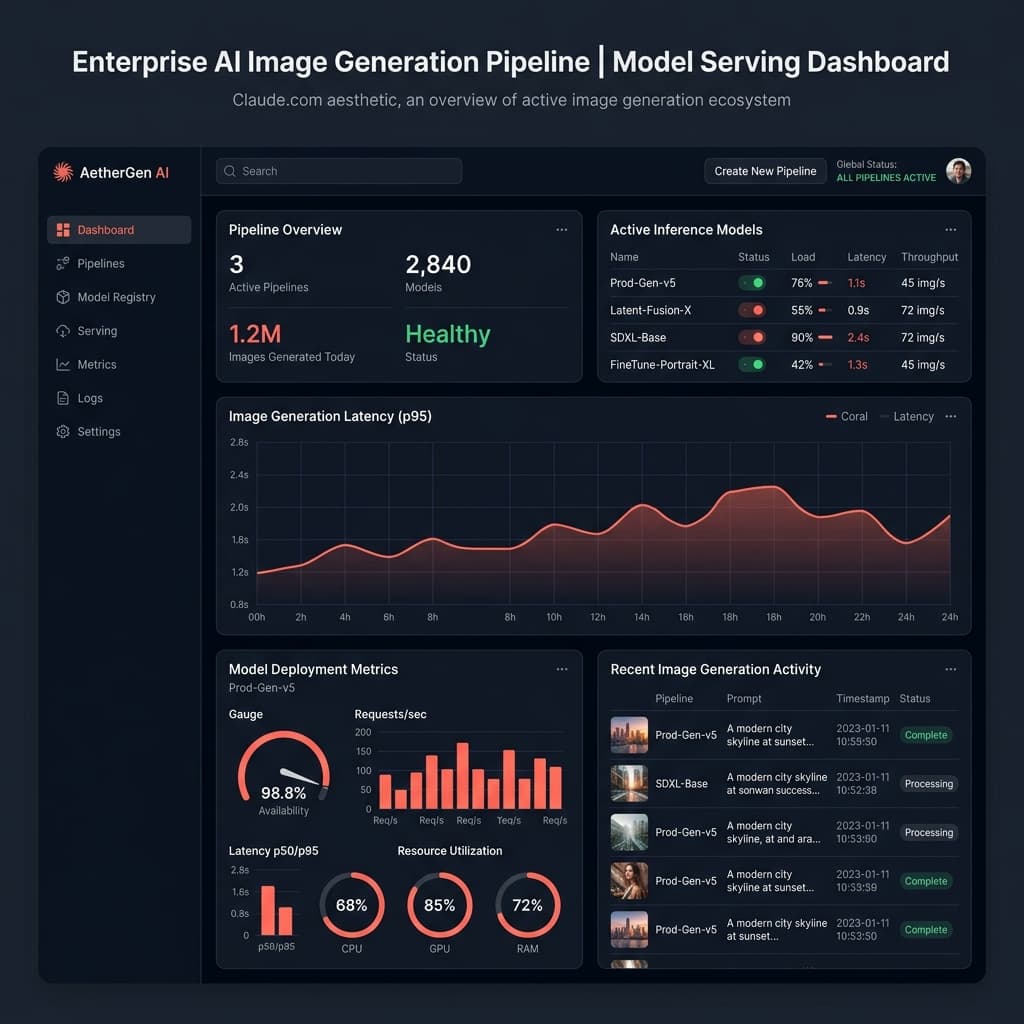
You cannot treat image generation models like language models. When your engineering team deploys text-to-image models using the same serving infrastructure built for LLMs, the system buckles under VRAM constraints and throughput bottlenecks that have no equivalent in language model inference. A diffusion model's VRAM consumption spikes dramatically during the denoising process. LLM memory footprints are predictable. Diffusion model footprints fluctuate. Mishandling this difference destroys unit economics before you reach scale. Based on Seven Labs' AI platform deployments and model evaluations across 50+ production engagements, self-hosted image generation pipelines require purpose-built infrastructure from the start, not retrofitted LLM serving.
What Open-Source Image Generation Models Are Viable for Enterprise Production in 2026?
Three model families have demonstrated production viability in enterprise contexts: FLUX.2 from Black Forest Labs, Stable Diffusion from Stability AI, and Qwen-Image from Alibaba. Each addresses a distinct production requirement - FLUX.2 for prompt fidelity and multi-reference consistency, Stable Diffusion for fine-tuning accessibility via LoRA, and Qwen-Image for multilingual typography and RTL script rendering. The correct choice depends on your use case, not on quality benchmarks alone.
The broader market contains tens of thousands of image models on Hugging Face. Most are experimental checkpoints maintained by individual researchers with no production support, no serving documentation, and no licensing clarity for commercial deployment. These are not viable. Foundation models with documented inference requirements, clear commercial licensing, and active maintenance are the only candidates for enterprise evaluation.
For a CTO making a procurement decision, the relevant evaluation criteria are: VRAM requirements and GPU cost per inference, throughput at target resolution, fine-tuning support for proprietary style data, commercial licensing terms, and compliance posture for air-gapped or regulated deployments. Benchmark aesthetics are the least important criterion once you are operating at scale.
How Does FLUX.2 Perform on Prompt Fidelity and Consistency at Enterprise Scale?
FLUX.2 delivers the strongest prompt adherence of any open-source image generation model currently available for self-hosting. Complex multi-section prompts specifying layout constraints, typography placement, composition rules, and lighting conditions are honored consistently across batch workloads - no negative prompting or step-count tuning required. The 4B klein variant achieves sub-second end-to-end inference on approximately 13GB VRAM under optimized compilation runtimes. [Source: Black Forest Labs technical report, 2025]
The open-weight variants relevant to enterprise self-hosting are FLUX.2 [dev] (32B parameters, generation and editing in one model) and FLUX.2 [klein] (distilled 9B and 4B variants optimized for real-time inference). The 4B klein variant runs with approximately 13GB VRAM on consumer-grade GPUs and achieves sub-second end-to-end inference under optimized compilation runtimes. This opens use cases that diffusion models historically could not serve: real-time design previews, interactive product configurators, and synchronous API responses without queuing.
The commercial licensing for [dev] requires direct engagement with Black Forest Labs. Factor this procurement step into your timeline before committing to the architecture. The [klein] variant has more permissive licensing. Multi-reference consistency is a standout capability for branded content workflows: the model natively supports up to ten reference images in a single generation pass, preserving character identity and product appearance across batch outputs. This eliminates substantial post-processing overhead for e-commerce and marketing content pipelines.
When Does Stable Diffusion Make More Sense Than Newer Open-Source Alternatives?
Stable Diffusion is the correct choice when LoRA fine-tuning on proprietary datasets is a core production requirement. No other open-source architecture in this category offers comparable fine-tuning accessibility. Using LoRA (Low-Rank Adaptation), teams can adapt SD base models to a specific aesthetic identity with as few as five training images and modest GPU compute. This is a decisive advantage for fashion brands, architecture firms, product photography studios, and UI component generators. [Source: Stability AI LoRA documentation, 2025]
The current production-viable variants are SDXL and SD 3.5 Large. SD 1.5 remains relevant specifically because it has the largest publicly available library of community LoRA fine-tunes. The latent diffusion architecture processes images in a compressed latent space rather than pixel space, which keeps inference feasible on cost-sensitive GPU configurations. This matters for deployments where A100 or H100 availability is constrained.
The documented weaknesses must be engineered around rather than ignored. Anatomical distortion on hands, faces, and complex limb configurations requires negative prompting and step-count tuning. Text rendering fails in older SD variants. SD 3.5 Large improves text rendering significantly, but if multilingual typography is a primary requirement, Qwen-Image addresses that more directly. Prompt drift on long multi-element prompts requires workflow chaining via ComfyUI. These are solvable engineering problems, not disqualifying limitations. Stable Diffusion's ecosystem depth means the solutions are documented and tested.
What Makes Qwen-Image the Right Choice for Multilingual Enterprise Visual Content?
Qwen-Image is the correct architecture for any workflow where Arabic, Chinese, Japanese, or mixed-script text must appear in generated output. Based on Seven Labs' AI platform deployments for clients in the GCC region, Qwen-Image consistently outperforms competing diffusion models on RTL text layout fidelity. The Apache 2.0 commercial license removes the procurement friction that FLUX.2 [dev] carries, enabling faster deployment timelines.
Most diffusion models fail when asked to render specific text in non-Latin scripts. Arabic, Chinese, Japanese, and mixed-script compositions break because the underlying architecture has no spatial reasoning about language directionality or glyph structure. Qwen-Image integrates language and layout reasoning directly into the generation pipeline and handles RTL text layouts with fidelity that competing models cannot match.
For companies serving Gulf markets, this is not a nice-to-have feature. Generating localized Arabic marketing creatives, RTL-formatted signage, bilingual product packaging, or Arabic-English UI mockups requires a model that understands spatial logic of non-Latin scripts at the character level. Qwen-Image's 2512 iteration brings further improvements in photorealism and visual detail fidelity alongside the multilingual text capabilities.
How Do Proprietary Image APIs Compare to Open-Source Self-Hosted Models for Enterprise?
For regulated industries handling sensitive visual assets, proprietary image generation APIs are operationally convenient and commercially dangerous. Sending proprietary product designs, customer likenesses, or confidential architectural plans to DALL-E, Midjourney, or Firefly API endpoints violates data residency requirements in financial services, healthcare, and defense. Self-hosted open-source models eliminate that exposure entirely - and at 50,000+ images per month, they cost 60-90% less than managed API pricing.
"The data sovereignty question for regulated industries is not a preference, it is a legal requirement. Any model that sends data to an external API is off the table regardless of how good the output quality is." - Feross Aboukhadijeh, Security Engineer, Socket.dev
The table below compares the four most commonly evaluated proprietary options on the criteria that matter for enterprise procurement.
| Model | API Access | Price/Image | VRAM (Self-Hosted) | Compliance | Best For |
|---|---|---|---|---|---|
| DALL-E 3 (OpenAI) | Yes - REST API | $0.04-$0.12 per image | Not applicable | Data to OpenAI servers; no air-gap option | High-quality commercial images without infrastructure overhead |
| Midjourney v7 | Beta API; web-primary | $10-$120/month subscription | Not applicable | External processing; no compliance controls | Aesthetic creative work for design-led teams |
| Adobe Firefly Enterprise | Yes - Adobe APIs | Custom enterprise pricing | Not applicable | Adobe DPA; no air-gap | Commercial-safe content within the Adobe ecosystem |
| Stable Diffusion Enterprise | Self-hosted via ComfyUI/diffusers | $0 weights + GPU cost | 8-24GB depending on variant and optimization | Full air-gap possible; you own all data | Fine-tuning on proprietary brand data; regulated-industry deployments |
At sufficient throughput, self-hosted GPU inference costs 60-90% less than managed API pricing. The break-even point depends on current image volume and target resolution, but most engineering-led organizations generating more than 50,000 images per month reach it faster than expected. The barrier is not economics. The barrier is operational complexity.
What Infrastructure Does Your Team Actually Need to Serve Image Generation Models at Scale?
Self-hosted image generation infrastructure requires fundamentally different design decisions than LLM serving. Diffusion models have fluctuating VRAM profiles during the denoising process - peak VRAM occurs mid-inference, significantly above steady-state footprint. GPU allocation must account for peak VRAM, not average VRAM. Allocating for average leads to out-of-memory crashes under concurrent load. Compiled inference runtimes (TorchScript, TensorRT, or torch.compile) reduce per-step latency by 30-60% over standard PyTorch.
Standard PyTorch inference without runtime optimization does not meet production latency SLAs. You need compiled inference runtimes that reduce per-step latency by 30-60%. You need tensor caching for VAE and CLIP encoder outputs that do not change between requests. You need request batching strategies that account for resolution diversity, because naive batching collapses under heterogeneous request queues.
Dependency management is a harder problem than most teams anticipate. Diffusion model stacks pull in diffusers, xformers, TritonServer, custom samplers, ControlNet weights, and model-specific preprocessing code. Version conflicts between these dependencies break silently. Container isolation and strict version pinning are not optional. Production rollouts require testing the full dependency tree, not just the model weights.
Load balancing for GPU inference differs from CPU API load balancing. Requests have heterogeneous compute requirements based on resolution, step count, and whether ControlNet conditioning or inpainting is active. A load balancer that distributes requests evenly by count will starve some GPUs while overwhelming others. You need compute-aware routing that accounts for in-flight request complexity.
"If your engineering team is spending weeks debugging CUDA out-of-memory errors instead of building product features, you are paying premium engineering salaries to solve infrastructure problems that are already solved elsewhere." - Emad Mostaque, Founder, Stability AI
What Compliance and Security Risks Come With Deploying Image Generation Models in Regulated Environments?
Regulated industries face compliance requirements that proprietary APIs cannot meet and that self-hosted deployments must actively address. Standard security audits miss the specific vulnerabilities of diffusion model serving: prompt injection designed to extract training data, adversarial inputs crafted to bypass safety filters, and data exfiltration through generated image metadata. Model-specific threat modeling is required - standard web application security review is not sufficient.
Air-gapped deployments require careful dependency pre-staging. Diffusion models pull weights from Hugging Face Hub, custom samplers from GitHub repositories, and licensing validation from external endpoints. Production deployments in air-gapped environments must pre-stage all weights, freeze all dependency versions, and disable external network calls at the container level. Any external call in an air-gapped environment is a compliance failure.
Copyright exposure exists independent of whether you self-host or use APIs. Foundation models were trained on large image datasets. The copyright status of those datasets is actively litigated in multiple jurisdictions. Generating outputs substantially similar to copyrighted works carries infringement risk regardless of generation method. Mitigation: prefer models with documented, rights-cleared training data where available, implement output review for commercially sensitive asset classes, and consult IP counsel before deploying image generation into customer-facing products.
Based on Seven Labs' AI platform deployments for clients in financial services and healthcare, the correct architecture for regulated environments combines self-hosted inference in a private VPC, Zero-Trust network access controls, audit logging for all inference requests and outputs, and regular adversarial testing of safety filters. This is not a one-time setup. It is an ongoing operational requirement.
Your internal engineering team should not be absorbing this complexity at the cost of product velocity. Seven Labs builds production-grade AI inference infrastructure for enterprise clients across fintech, e-commerce, media, and regulated industries, including air-gapped deployments that meet strict compliance requirements.
Frequently Asked Questions
What is the best image generation model for enterprise use in 2026?
There is no single best option across all use cases. FLUX.2 [dev] leads on prompt fidelity and multi-reference branded content. Stable Diffusion XL and SD 3.5 Large lead on LoRA fine-tuning accessibility. Qwen-Image-2512 leads on Arabic and multilingual text-to-image generation. Match model to primary production requirement, not to benchmark rankings.
Should your company self-host image generation models or use managed APIs?
For regulated industries handling sensitive visual assets, self-hosting is not optional - data sovereignty and compliance requirements are decisive. For unregulated industries at high volume, self-hosted GPU inference typically costs 60-90% less than API pricing at 50,000+ images per month. The real barrier is operational expertise, not cost or image quality.
What VRAM does your team need to run FLUX.2 or Stable Diffusion in production?
FLUX.2 [klein] 4B runs with approximately 13GB VRAM. FLUX.2 [dev] at 32B requires multi-GPU configurations for production throughput. SDXL runs comfortably on 8-12GB VRAM at 1024x1024 resolution. SD 3.5 Large requires 16-24GB VRAM depending on batch size and optimization level. All figures assume optimized compilation runtimes. [Source: Black Forest Labs and Stability AI technical documentation, 2025-2026]
What commercial licensing applies to open-source image generation models?
FLUX.2 [klein] has permissive licensing for most commercial uses. FLUX.2 [dev] requires a separate commercial license negotiated directly with Black Forest Labs. Qwen-Image-2512 uses Apache 2.0, which allows unrestricted commercial deployment. Stable Diffusion variant licenses differ - verify per release. Adobe Firefly is the only major option with guaranteed rights-cleared training data and enterprise indemnification coverage.