
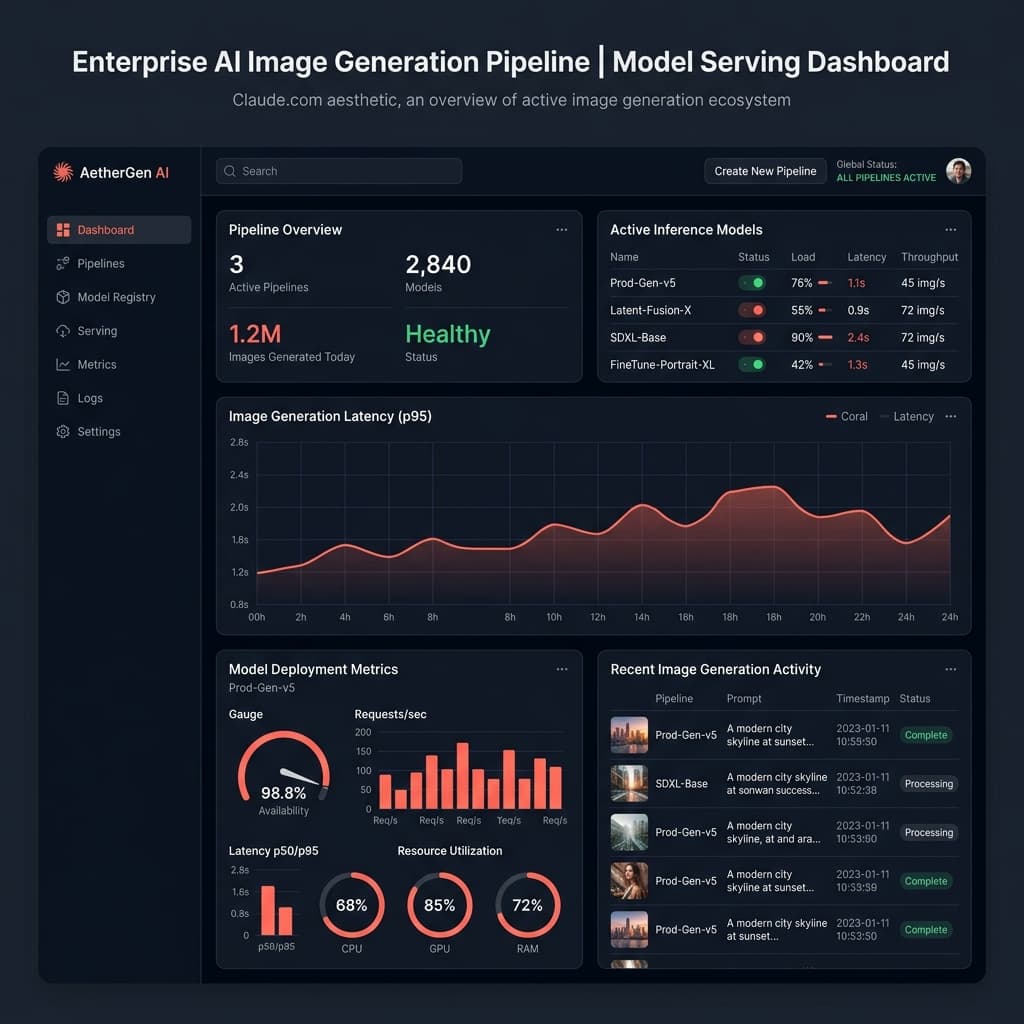
The Best Open-Source Image Generation Models in 2026: A Production Engineering Guide
If you manage infrastructure for a company that generates visual content at scale, you are facing a problem that most mainstream AI coverage fails to address honestly. There are over 90,000 text-to-image models indexed on Hugging Face alone. Nearly all of them are experimental checkpoints maintained by individual researchers. The handful that are production-viable require infrastructure expertise most teams do not have in-house.
This guide cuts through the noise. Based on Seven Labs' AI platform deployments and model evaluations, we assess the six most significant open-source image generation models of 2026 from an enterprise deployment perspective, not from a hobbyist perspective. We then answer the questions that every engineering leader is actually asking when deciding whether to self-host visual AI or continue paying for proprietary APIs they cannot trust with sensitive data.
Why Are Open-Source Image Generation Models Replacing Proprietary APIs in Enterprise Environments?
Open-source image generation models now match proprietary APIs on output quality for most enterprise use cases - while giving your organization full data sovereignty, air-gap capability, and 60-90% lower cost per image at volume. The structural shift is irreversible for any company handling sensitive visual assets or operating in a regulated industry.
Proprietary image generation APIs - Midjourney, DALL-E, Adobe Firefly - are operationally convenient but commercially dangerous for any company handling sensitive visual assets. Sending proprietary product designs, customer likenesses, or confidential architectural plans to an external API endpoint violates data residency requirements in most regulated industries and exposes IP to third-party training pipelines.
Open-source models eliminate that risk. You own the weights, you run the inference, and your data never leaves your infrastructure. The tradeoff is complexity: GPU allocation, VRAM management, latency optimization, and dependency orchestration are all problems you must solve internally, or partner with an engineering team that already has.
The good news is that open-source quality in 2026 has reached parity with proprietary APIs for a wide range of use cases. The models below prove it.
Is FLUX.2 Now the Benchmark for Open-Source Text-to-Image Generation in Production?
FLUX.2 is the open-source image generation model that finally closed the quality gap with frontier proprietary systems. Released by Black Forest Labs in November 2025, it delivers consistent prompt obedience across batch workloads at sub-second inference speeds on approximately 13GB VRAM with the 4B klein variant. For most enterprise branded content and e-commerce image pipelines, FLUX.2 is the correct starting point in 2026.
FLUX.2 is available in four configurations:
- FLUX.2 [pro] - State-of-the-art image quality, managed API only
- FLUX.2 [flex] - Developer-controllable generation parameters, API only
- FLUX.2 [dev] - 32B open-weight model, supports generation and editing, runs on consumer GPUs, commercial license required separately from Black Forest Labs
- FLUX.2 [klein] - Distilled 9B and 4B variants optimized for real-time inference. The 4B model runs on consumer GPUs with approximately 13GB VRAM and achieves sub-second end-to-end inference
For enterprise self-hosting, [dev] and [klein] are the relevant configurations.
Why FLUX.2 Belongs in Your Production Stack
Prompt obedience at scale. FLUX.2 follows complex, multi-section prompts with a reliability that earlier diffusion architectures could not match. You can specify layout constraints, lighting conditions, typography placement, and composition rules, and the model honors them consistently across batch workloads. This matters when you are generating thousands of marketing assets that must adhere to brand guidelines.
Multi-reference consistency. The model natively supports up to ten reference images in a single generation pass, with strong preservation of character identity and product appearance. For e-commerce platforms, branded content workflows, or recurring-character creative pipelines, this eliminates a significant amount of post-processing overhead.
Sub-second inference is achievable. With optimized compilation runtimes, FLUX.2 [klein] can achieve sub-second generation at production quality. This opens use cases that diffusion models historically could not serve: real-time previews, interactive design tools, and synchronous API responses.
Infrastructure Considerations for FLUX.2
The full [dev] architecture demands significant GPU allocation. Running it with standard PyTorch inference will not meet any reasonable latency SLA. You need optimized runtimes and tensor compilation strategies to bring latency to acceptable levels.
The commercial licensing for [dev] also requires direct engagement with Black Forest Labs. Factor this into your procurement timeline before committing to the architecture.
Is Stable Diffusion Still Worth Deploying When Newer Diffusion Models Exist in 2026?
Stable Diffusion remains the right choice in 2026 for any production use case where LoRA fine-tuning on proprietary datasets is a core requirement. No other open-source architecture in this guide offers comparable fine-tuning accessibility. The ecosystem depth - four years of community LoRA libraries, ComfyUI custom nodes, and battle-tested serving patterns - is a genuine competitive advantage that newer models cannot replicate.
Stable Diffusion has been the industry baseline since 2022. It remains highly relevant not because it leads on raw quality metrics, but because its ecosystem depth is unmatched. When you deploy Stable Diffusion, you are not just deploying a diffusion model. You are accessing four years of community fine-tunes, LoRA libraries, ComfyUI custom nodes, and battle-tested serving patterns.
The current model family includes SD 1.4, 1.5, 2.0, SDXL, SDXL Turbo, SD 3.5 Medium, SD 3.5 Large, and SD 3.5 Large Turbo. For new deployments, SDXL and SD 3.5 Large are the practical starting points. SD 1.5 remains relevant specifically because it has the largest library of LoRA fine-tunes.
The Technical Reality of Stable Diffusion in Production
The latent diffusion architecture processes images in a compressed latent space rather than pixel space, which is what makes inference feasible on consumer-grade hardware. This is a significant advantage for cost-sensitive deployments.
The weaknesses are well-documented and must be engineered around:
- Anatomical distortion - Hands, faces, and limbs degrade under complex prompting. Negative prompting and step-count tuning mitigate this but require workflow expertise.
- Text rendering failures - Older SD variants cannot reliably render text within images. SD 3.5 Large improves this significantly, but if multilingual typography is a core requirement, other architectures in this guide serve that need better.
- Prompt drift in complex scenes - Long, multi-element prompts cause the model to deprioritize constraints. Prompt chaining via ComfyUI is the established solution.
When Stable Diffusion Is the Right Call
Choose Stable Diffusion when your use case benefits from fine-tuning on proprietary datasets. With LoRA, you can adapt SD base models to a specific aesthetic identity - architectural firm styles, fashion brand palettes, product photography conventions - using as few as five training images and modest compute. No other architecture in this guide offers the same fine-tuning accessibility.
Is GLM-Image the Right Open-Source Model for Dense Text and Structured Visual Layouts?
GLM-Image is the correct open-source choice for workflows where generated images must contain legible, accurately placed text - especially Chinese and mixed-language typography. Its hybrid autoregressive-plus-diffusion architecture outperforms pure diffusion models on structured layouts like signage, packaging, infographics, and UI mockups. If text accuracy in generated output is your primary requirement, GLM-Image is the most capable open-source option available in 2026.
GLM-Image, developed by Zhipu AI, uses a hybrid architecture that pairs a 9B autoregressive generator (initialized from GLM-4-9B) with a 7B single-stream diffusion decoder. The AR module handles global semantics and layout; the diffusion decoder reconstructs high-frequency detail.
The practical result is a model that significantly outperforms pure diffusion architectures in two production scenarios:
Dense text rendering - GLM-Image includes a dedicated Glyph Encoder that improves text accuracy within generated images, including Chinese and mixed-language typography. If your workflow involves generating signage, packaging, infographics, or any output where text must be legible and correctly placed, GLM-Image is the most capable open-source option for that specific requirement.
Knowledge-intensive layouts - Menus, posters, UI mockups, instructional graphics, and information-dense compositions are scenarios where pure diffusion models lose structural coherence. GLM-Image's autoregressive module preserves the information hierarchy even in complex prompts.
Production Notes for GLM-Image
Target resolution must be divisible by 32 or inference will fail. For text rendering quality specifically, wrapping intended text in quotation marks within the prompt and using GLM-4.7 for prompt enhancement yields measurably better results.
GLM-Image supports both generation and editing in a single model, which simplifies infrastructure compared to maintaining separate generation and inpainting pipelines.
Does Z-Image-Turbo Deliver the Best Inference Speed-to-Quality Ratio for High-Volume Image Generation?
Z-Image-Turbo delivers production-quality image generation at sub-second latency on enterprise GPUs within 16GB VRAM on consumer cards, under Apache 2.0 licensing with no additional procurement overhead. On quality benchmarks, it matches or exceeds FLUX.2 [dev], HunyuanImage-3.0, and Google's Imagen 4 while requiring only a fraction of the inference steps - which translates directly to lower cost-per-image at scale.
Z-Image is a 6B parameter model designed from the ground up for speed without sacrificing quality. The flagship variant, Z-Image-Turbo, is a distilled model optimized for ultra-fast inference. It achieves sub-second latency on enterprise GPUs and operates within 16GB VRAM on consumer cards.
On quality benchmarks, Z-Image-Turbo matches or exceeds FLUX.2 [dev], HunyuanImage 3.0, and Google's Imagen 4 while requiring only a fraction of the inference steps. This translates directly to cost-per-image economics: fewer steps, lower compute cost, higher throughput.
The model is released under Apache 2.0 licensing, which means commercial deployment without additional licensing overhead or vendor negotiations.
Z-Image-Turbo in High-Volume Pipelines
If your use case involves large-scale batch image generation - product photography for e-commerce catalogs, programmatic ad creative generation, or data augmentation for computer vision training sets - Z-Image-Turbo's throughput profile is exceptional. The accuracy of bilingual English and Chinese text rendering also makes it viable for markets where multilingual visual content is a primary output.
The ecosystem caveat: Z-Image has fewer third-party tools, community fine-tunes, and published serving patterns than Stable Diffusion or FLUX. Factor in additional engineering time for toolchain integration.
Is Qwen-Image-2512 the Best Open-Source Model for Arabic and Multilingual Content Pipelines?
Qwen-Image-2512 is the production standard for any open-source image generation pipeline requiring accurate Arabic, Chinese, Japanese, or mixed-script text rendering. Based on Seven Labs' AI platform deployments for clients in the GCC region, Qwen-Image consistently outperforms competing diffusion models on RTL layout fidelity. The Apache 2.0 license removes procurement friction entirely.
Developed by Alibaba's Qwen team, Qwen-Image is the image generation component of the Qwen model series. The 2512 iteration brings significant improvements in photorealism, visual detail fidelity, and text rendering accuracy. It is licensed under Apache 2.0 for commercial use.
Why Qwen-Image Is Critical for Gulf and Asian Market Deployments
Most diffusion models fail at multilingual typography. Arabic, Chinese, Japanese, and mixed-script layouts consistently break because the underlying architecture has no language-aware spatial reasoning. Qwen-Image integrates language and layout reasoning directly into its generation pipeline.
For companies serving the Gulf market, this is not a nice-to-have. It is a fundamental requirement. Generating localized Arabic marketing creatives, RTL-formatted signage, or bilingual product packaging requires a model that understands the spatial logic of non-Latin scripts. Qwen-Image handles this with a fidelity that competing architectures cannot match.
The Broader Qwen-Image Ecosystem
The Qwen-Image family extends beyond the base generation model:
- Qwen-Image-Edit-2509 - Fine-tuned for instruction-based image editing, supporting operations across one to three input images. Adds ControlNet-based conditioning via depth maps, edge maps, and keypoint maps.
- Qwen-Image-Layered - Introduces a layered RGBA representation for non-destructive editing. Independent layers enable precise operations: recoloring, repositioning, object replacement, and deletion without affecting the rest of the composition.
- Qwen-Image-Lightning - A distilled speed-optimized variant delivering 12x to 25x faster inference in 4 to 8 steps with no significant quality loss. The right choice for real-time and high-throughput workflows where the full model is too slow.
For complex multilingual content workflows serving the GCC region or East Asian markets, Qwen-Image-2512 paired with Qwen-Image-Lightning for latency-sensitive endpoints represents the current state of the art in open-source deployments.
Is HunyuanImage-3.0 Operationally Viable for Enterprise Deployment at 80B Parameters?
HunyuanImage-3.0 is operationally viable for enterprise teams that need to process thousand-word prompts or generate contextually rich scenes from sparse briefs. It is not a general-purpose replacement for FLUX.2 or Stable Diffusion - it is a specialist model for long-prompt coherence and world-knowledge inference. Serious GPU infrastructure is required: this is a multi-GPU deployment, not a single-A100 workload.
Developed by Tencent's Hunyuan team, HunyuanImage-3.0 is a fundamentally different architecture from every other model on this list. It is a native multimodal autoregressive model, not a DiT-style diffusion pipeline. Text and image tokens are modeled in a unified framework, which changes what the model can do.
It is also the largest open-source image generation model ever released: 80B total parameters with 64 experts and approximately 13B active parameters per inference step.
The model was trained on 5 billion image-text pairs, video frames, interleaved image-text data, and 6 trillion text tokens. This hybrid training approach gives HunyuanImage-3.0 a depth of world-knowledge reasoning that pure vision-only models lack.
The Operational Case for HunyuanImage-3.0
Thousand-word prompt processing. The model can parse extremely long, detailed prompts and maintain coherence across all specified constraints. If your content team is generating complex scene descriptions - interior design specifications, architectural briefs, detailed product staging instructions - HunyuanImage-3.0 handles this where smaller models fail.
World-knowledge inference. Because the model was trained on text tokens at scale, it infers contextually appropriate details from sparse prompts. A brief like "a Dubai marina boardwalk at golden hour during Ramadan" generates a coherent, contextually accurate scene rather than a generic waterfront.
Infrastructure Requirements
An 80B MoE model requires serious infrastructure planning. This is not a model you test on a single A100. Production serving requires multi-GPU configurations and careful attention to expert routing and memory bandwidth. The current release focuses exclusively on text-to-image; image editing and multi-turn interaction are planned for subsequent releases.
"The gap between open-source and proprietary image generation has effectively closed for most enterprise use cases. The remaining gap is not quality - it is infrastructure expertise." - Emad Mostaque, Founder, Stability AI
"For regulated industries, the question was never whether open-source models were good enough. It was whether your team could operate them safely at scale. That bar is now achievable with the right infrastructure partner." - Feross Aboukhadijeh, Security Engineer, Socket.dev
Frequently Asked Questions for Engineering Leaders
What is the best open-source image generation model for enterprise use in 2026?
There is no single best model across all production requirements. FLUX.2 [dev] leads on prompt fidelity and multi-reference branded content. Stable Diffusion XL and SD 3.5 Large lead on LoRA fine-tuning accessibility. Qwen-Image-2512 leads on Arabic and multilingual text-to-image output. Z-Image-Turbo leads on throughput-per-dollar. Match the model to your primary use case requirement.
Should your engineering team self-host image generation models or use managed APIs?
For regulated industries - fintech, healthcare, defense, legal - self-hosting is almost always the correct answer. Data sovereignty requirements are decisive. For unregulated industries at high volume, self-hosted GPU inference costs 60-90% less than managed API pricing at 50,000+ images per month. The real barrier is operational complexity, not cost or output quality.
What VRAM requirements should your team plan for in a self-hosted image generation deployment?
FLUX.2 [klein] 4B runs on approximately 13GB VRAM. SDXL runs comfortably on 8-12GB VRAM at 1024x1024. SD 3.5 Large requires 16-24GB VRAM depending on batch size and optimization. Z-Image-Turbo operates within 16GB VRAM on consumer cards. HunyuanImage-3.0 at 80B requires multi-GPU configurations. All specs assume optimized compilation runtimes, not standard PyTorch.
What commercial licensing terms apply to the open-source image generation models in this guide?
FLUX.2 [klein] and Qwen-Image-2512 have permissive commercial licenses - Apache 2.0 in Qwen's case. FLUX.2 [dev] requires a separate commercial license from Black Forest Labs. Z-Image-Turbo uses Apache 2.0 with no additional overhead. Stable Diffusion variant licenses differ - verify per release. Consult IP counsel before deploying any model into customer-facing products generating commercial assets.
Which Open-Source Image Generation Model Matches Your Production Use Case?
| Use Case | Recommended Model |
|---|---|
| General high-quality generation, branded content | FLUX.2 [dev] or [klein] |
| Fine-tuning on proprietary style data | Stable Diffusion XL or 3.5 Large |
| Dense text and multilingual typography | GLM-Image or Qwen-Image-2512 |
| High-throughput batch generation | Z-Image-Turbo |
| Gulf / Arabic market visual content | Qwen-Image-2512 |
| Complex long-prompt scene generation | HunyuanImage-3.0 |
| Real-time interactive generation | FLUX.2 [klein] or Qwen-Image-Lightning |
What Should Your Team Do After Selecting an Open-Source Image Generation Model?
Selecting the right model resolves 10% of your deployment challenge. The remaining 90% is infrastructure, and it is where most in-house efforts underestimate the complexity.
Optimized inference runtimes, GPU allocation strategies, auto-scaling configurations, model versioning, security hardening for regulated environments, and workflow orchestration for multi-step pipelines are all problems that must be solved before you can ship a production-grade image generation system. ControlNet integration, LoRA serving, ComfyUI workflow productionization, and VRAM peak management require hands-on infrastructure experience that takes months to develop internally.
If your engineering team is absorbing that complexity at the expense of product development velocity, the trade-off is almost never worth it.
Seven Labs builds production image generation infrastructure for enterprise clients across fintech, e-commerce, media, and regulated industries. We design the serving architecture, handle GPU orchestration, and deploy secure pipelines tailored to your operational constraints.
Schedule a technical consultation to scope your image generation deployment.
For teams operating in security-sensitive environments, we also design air-gapped and Zero-Trust AI deployments that meet the compliance requirements of financial services and healthcare. Review our approach to secure AI infrastructure.