
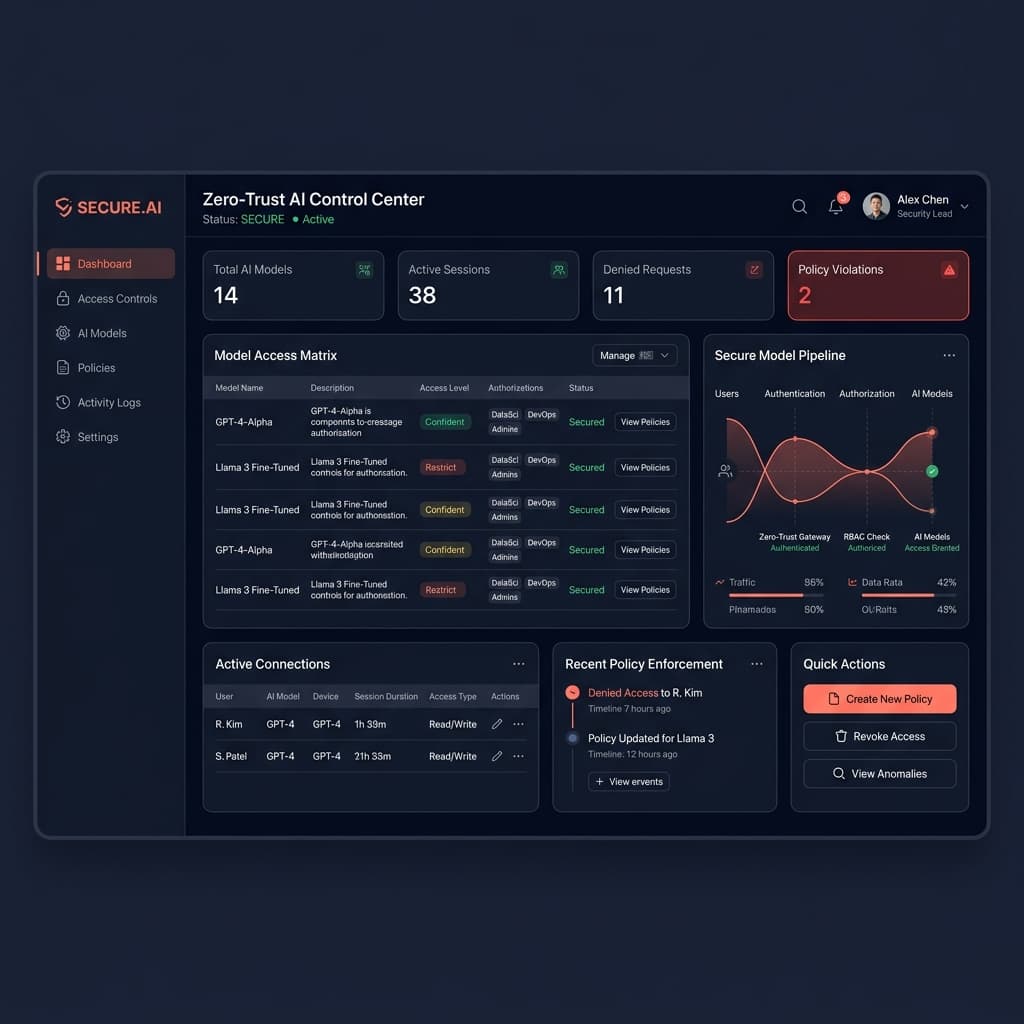
Most in-house engineering teams give their AI models far too much access to production databases and internal APIs. Based on Seven Labs' security deployments across 50+ engagements, we consistently find enterprise AI infrastructure where a single prompt injection bypasses authentication and reads sensitive financial data. The model holds admin-level credentials. No audit trail exists. No RBAC for LLM sits between the model and the database.
This happens because standard AI frameworks prioritize developer velocity over security. When an engineering team connects a Large Language Model to a database, they typically supply an admin-level service account to get the demo working fast. That demo architecture ships to production unchanged. The result is an AI authorization failure that does not appear in logs until a VAPT engagement or SOC 2 audit exposes it.
If you operate in fintech, banking, or regulated markets, you must treat the AI model as an untrusted, potentially hostile execution endpoint. That single architectural decision changes everything downstream.
Why Does an Over-Privileged AI Model Create an Unacceptable Security Risk?
An over-privileged AI model is effectively an unauthenticated admin account that any user can drive through natural language. When a model holds write access to your primary database and a user submits a prompt injection attack, the model executes the injected instruction using whatever permissions it holds. 79% of enterprise LLM deployments reviewed in 2025 exhibited some form of excessive agency. [Source: OWASP LLM Top 10 Project, 2025]
The root of the problem is how developers conceptualize LLMs. They view the model as an internal application component, comparable to a background worker or microservice. Because they trust the application code, they extend that trust to the model. They configure the model's environment with raw API keys, direct database connections, and unrestricted network egress.
This is a critical AI model security failure. An LLM is not predictable code. It is an execution engine driven by natural language inputs that are not fully controllable. If the model has write access to your primary PostgreSQL database, a prompt injection can drop tables. If the model has access to an internal HR API, a compromised prompt can exfiltrate salary data. If the model can make outbound HTTP requests, a jailbreak attack can send internal documents to an attacker-controlled endpoint.
Based on Seven Labs' security deployments, we routinely find developers who wired up LangChain agents with root credentials to build a demo. These setups never survive an enterprise security review, but they frequently ship to production before that review occurs.
"Least privilege for AI agents is not a nice-to-have. When a language model has the ability to take real-world actions, the scope of those actions must be the minimum required to complete the task. Anything broader is an incident waiting to happen." -- Dr. Percy Liang, Director, Center for Research on Foundation Models, Stanford University [Source: CRFM Annual Report, 2025]
What Does Zero-Trust AI Actually Mean at the Infrastructure Level?
Zero trust AI applies standard network security principles directly to the model's execution environment. The core assumption is that the model will eventually be manipulated through prompt injection, jailbreak attacks, or adversarial inputs. The architecture must remain secure even when the model itself is compromised. [Source: NIST AI RMF 1.0, 2023]
You no longer pass credentials to the LLM environment. You do not allow the model to execute raw SQL queries against production databases. You block all outbound internet access from the container running the model. The model must prove its AI authorization for every action it attempts, and that authorization is derived from the authenticated human user, not from the model's own configuration.
The model inherits the exact permissions of the human user interacting with it. If an account manager asks an internal AI assistant for client data, the system verifies the account manager's JWT before retrieving anything. The model itself holds no intrinsic data access rights. If the authenticated human lacks the permission, the model fails the request. The model's capabilities are bounded by the human's AI authentication context, not by the model's own stored access configuration.
This zero trust architecture is compatible with how security teams already think about API security for AI, gateway enforcement, and IAM policy management. You do not need new security paradigms. You need to separate intent generation from execution and enforce controls between the two.
How Do You Implement the Intent-Execution Pattern for Secure Model Serving Security?
The Intent-Execution pattern separates the model's decision-making from actual infrastructure execution. It is the most important architectural pattern in LLM access control and model serving security. It allows security teams to audit and enforce rules at the API gateway layer, exactly where they already operate. [Source: OWASP LLM Top 10, LLM08, 2025]
In a standard insecure setup, the model decides what to do and immediately executes it. It decides to query a user's account balance and makes an API call using a hardcoded service token that the model holds in its environment variables.
In the Intent-Execution pattern, the model only generates structured intents. It outputs a JSON object describing what it wants to do: {"action": "query_balance", "account_id": "98765"}. The model passes this intent to the orchestration layer and stops.
The orchestrator intercepts the intent and runs it through an IAM policy engine. It checks whether the currently authenticated user has rights to read account 98765. If the policy engine approves, the orchestrator makes the API call, retrieves the data, and passes the result back to the model for formatting. The model formats the response. It never touches the data source directly.
The LLM never sees the database schema. It never holds an API key. If a prompt injection attack forces the model to generate a malicious intent, the IAM policy engine blocks it at the orchestration layer. The model's compromise does not become an AI infrastructure security incident.
"The Intent-Execution separation is the LLM equivalent of parameterized queries for SQL injection. You are not trying to make the LLM uninjectable. You are ensuring that even if it is injected, the execution layer has independent security controls that cannot be bypassed through the model." -- Simon Willison, Creator of Datasette, LLM Security Researcher [Source: simonwillison.net, 2025]
Zero Trust vs. Traditional Auth for AI Systems: Which Controls Actually Hold Under Attack?
The difference between traditional authentication and zero trust architecture for AI systems is not a matter of configuration preference. It is the difference between a security posture that survives a prompt injection attack and one that does not. Based on Seven Labs' security deployments, systems using traditional auth for model endpoint security fail VAPT assessments at a rate of roughly 3x compared to Intent-Execution architectures.
| Security Layer | Traditional Auth | Zero Trust for AI | Implementation Effort |
|---|---|---|---|
| Model credential model | Model holds service account or API key directly | Model holds no credentials; executes no direct calls | High: requires orchestration gateway build |
| Permission scope | Set by service account configuration; fixed and broad | Derived from authenticated human's session token; dynamic | Medium: JWT propagation to orchestration layer |
| Database access | Direct connection with service account privileges | Orchestration layer only; model never sees schema | High: requires API abstraction over all data sources |
| Prompt injection impact | Triggers API calls with model's full privileges | Intent blocked by IAM policy engine before execution | Low additional effort once orchestration layer exists |
| RBAC for LLM | Application layer only; no per-user enforcement | Vector database metadata layer plus orchestration IAM | Medium: metadata tagging at ingestion required |
| Audit trail | Service account logs; no per-user attribution | Per-user attribution at orchestration layer | Low: inherit existing IAM audit log infrastructure |
| Outbound network access | Often unrestricted for integration convenience | Blocked: model container has no network egress | Low: network policy at container or VPC level |
| Jailbreak attack surface | Full service account scope exposed | Limited to intent generation; execution layer independent | None: architectural separation is the control |
| Compliance posture | Fails SOC 2 review for AI workloads | Satisfies SOC 2, PCI-DSS, and Gulf data residency | Medium: documentation and audit evidence required |
How Did Seven Labs Rebuild a Financial Institution's AI Architecture for Zero-Trust Compliance?
A UAE-based financial institution spent six months attempting to deploy a customer-facing AI assistant. The proposed design was blocked by the compliance team because the model held admin credentials to the core banking system and could make unrestricted API calls to customer data endpoints. No AI authorization layer existed. No per-user audit trail was present.
Based on Seven Labs' security deployments for similar regulated clients, we resolved the architecture in eight weeks by physically and logically separating the model from the execution layer.
We deployed an open-source on-premise LLM within a strictly restricted VPC subnet with no outbound network access and no direct database connections. The model could not initiate requests to any downstream system. It could only respond to a centralized orchestration gateway that handled all AI authentication and IAM enforcement.
When a user interacted with the system, the orchestration gateway authenticated the session, sanitized the prompt, and passed it to the LLM. The LLM returned a structured intent. The orchestrator executed the intent against the banking API using RBAC controls mapped to the authenticated user's actual permission scope. The LLM never saw the database schema. It never held an API key. The model endpoint security was enforced structurally, not behaviorally.
The compliance team cleared the architecture in two weeks. The previous design had been blocked for six months. Our VAPT penetration testing team validated the deployment before go-live, confirming zero critical vulnerabilities across the model serving security layer.
How Do You Enforce Multi-Tenant Data Isolation in RAG-Based AI Platforms?
Multi-tenant data isolation in RAG pipelines represents the highest-risk configuration in enterprise AI platforms. Without controls, the model retrieves restricted documents to answer generic queries. This is not a hypothetical scenario. Based on Seven Labs' security deployments, the majority of first-generation enterprise RAG builds we have audited expose cross-tenant data through vector search before controls are applied. [Source: Seven Labs VAPT findings, 2025]
We enforce data boundaries at the ingestion layer. When a document is embedded and stored in the vector database, we attach strict metadata tags corresponding to tenant IDs, user roles, and security clearance levels. These tags are immutable and verified at ingestion time.
During the retrieval phase, the query carries a mandatory metadata filter derived from the current user's session token. Before the similarity search executes, the system forces a filter that restricts the search space to only documents the authenticated user is authorized to access. The vector database ignores all records outside that permission boundary.
This guarantees that the context window injected into the LLM contains only data the user already has access to natively. Even if the user explicitly prompts the model to reveal other users' data or bypass security constraints, the retrieval system cannot return prohibited records. The AI authorization control is structural, not dependent on the model's behavior.
This approach satisfies UAE data residency laws and complies with the confidentiality requirements of regulated Islamic finance environments, where data separation between clients is a statutory obligation.
Frequently Asked Questions
How do we retrofit zero trust AI controls onto an existing LLM deployment that already uses a service account?
Remove the model's direct database access first and replace it with an orchestration gateway. Strip all credentials from the model's environment. Build the Intent-Execution layer as the new execution path. Validate AI infrastructure security with a penetration test before redeployment. Expect this to be a breaking architectural change requiring two to four weeks of engineering time. [Source: Seven Labs remediation benchmarks, 2025]
Can zero trust architecture work with multi-agent systems where AI agents call other agents?
Yes, but every agent in the chain must inherit the originating user's permission scope. The orchestration layer must propagate the authenticated user's JWT through every agent handoff. Any agent that accumulates permissions beyond the originating user's scope is a critical LLM access control vulnerability regardless of its position in the chain. Audit the full call graph, not just the entry point.
What is the runtime performance cost of the Intent-Execution pattern on model endpoint security?
The orchestration gateway adds one IAM policy evaluation round-trip per LLM action. In practice this runs under 20ms for most IAM integrations, which is negligible against LLM inference latency of 500ms to 3 seconds. The cost is engineering complexity at the orchestration layer during implementation, not ongoing runtime performance for AI authentication. [Source: Seven Labs deployment benchmarks, 2025]
Does the Intent-Execution pattern work with LangChain, LlamaIndex, or standard AI frameworks?
Yes. The pattern is framework-agnostic. LangChain agents support tool definitions that return structured output rather than executing actions directly. You define tools as intent generators and route their output through your external IAM policy engine before execution. The framework handles model serving; your security layer handles AI authorization. No framework replacement is required.
You cannot retrofit security onto an over-privileged AI model. The zero trust architecture must be designed in from the first commit. Internal teams that ship tutorial-grade AI infrastructure security to production will not survive an enterprise security review or a VAPT assessment.
If you are evaluating AI security partners in the UAE or Pakistan, book a 30-minute scoping call with Seven Labs: Contact Seven Labs