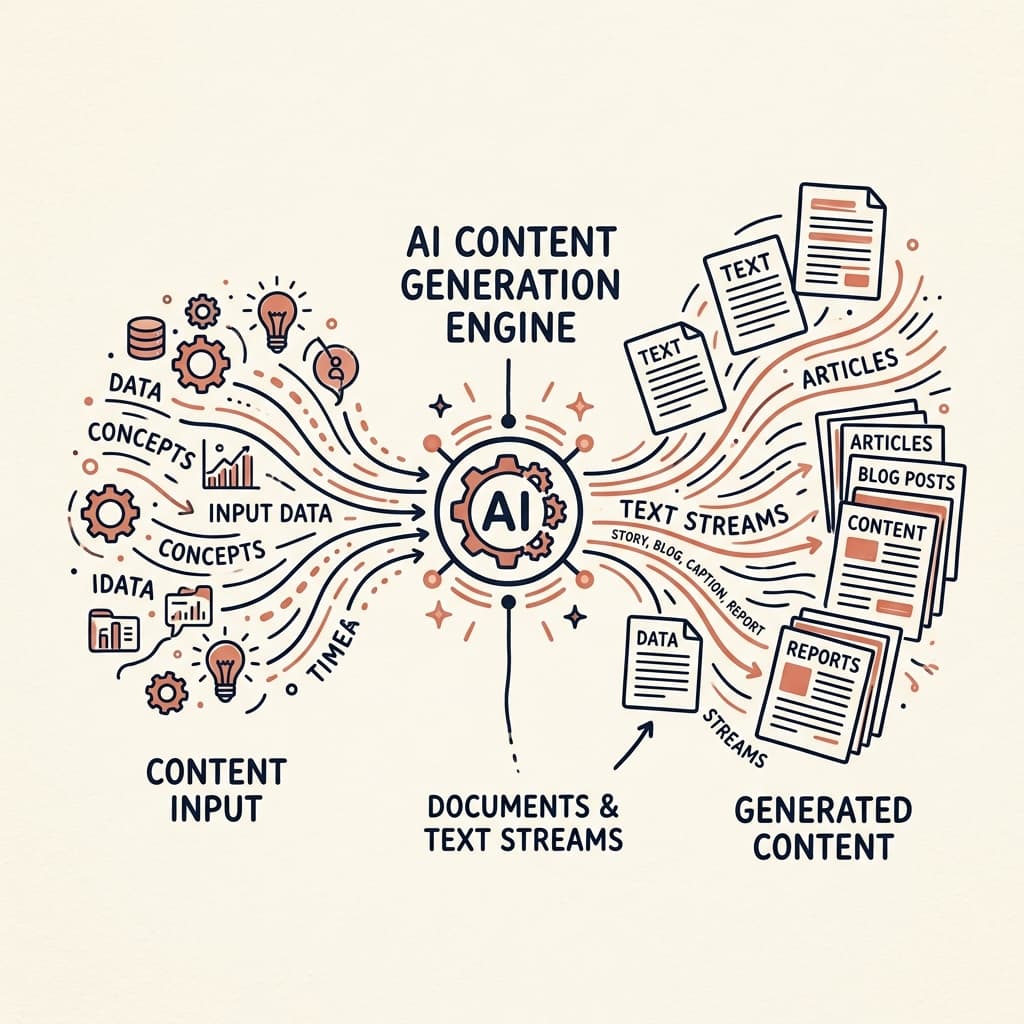
Case Study: RawAI - Automated Multi-Channel Content Platform
Executive Summary
This case study details the engineering and deployment of RawAI, an enterprise-grade automated content production and distribution platform. Over a 10-week engagement, Seven Labs designed and built an asynchronous, multi-agent AI pipeline that scales content generation from high-level strategic briefs to publication-ready marketing assets. The solution ingests seed keywords, parses search engine results pages (SERPs) for competitor structure, maps intent, drafts structured long-form content, and automatically repurposes that content into channel-native formats for LinkedIn, X (formerly Twitter), and newsletters.
By moving from a human-only content creation process to a high-fidelity AI content infrastructure, the client achieved a 12x content production velocity, reduced content production costs by 85%, and drove a 4x increase in organic traffic over a six-month tracking period. The platform was built using OpenAI GPT-4o, LangChain, Node.js, MongoDB, and Redis.
Business Problem
The client, a high-growth B2B SaaS provider, faced a common scale bottleneck: their content marketing strategy was constrained by high creation costs and slow execution times. Operating in a highly competitive vertical, they needed to build topical authority by publishing at least 30-40 comprehensive, high-quality technical articles per month. However, their three-person marketing team could only produce 4 high-quality articles monthly.
Hiring an external B2B agency to meet this volume would require a capital outlay exceeding $180,000 annually. Furthermore, manual writing cycles introduced significant lag times, making it difficult to capitalize on trending market events. The client's initial attempts to use standard, off-the-shelf generative AI interfaces (like ChatGPT web interfaces) failed due to:
- Lack of Style Fidelity: The generated output sounded generic, repetitive, and lacked the brand's authoritative voice.
- Structural Deficiencies: Articles were filled with fluff, failed to address specific search intent, and lacked systematic search engine optimization (SEO).
- Lack of Distribution Automation: Repurposing long-form content into social media formats remained a slow, manual copy-paste exercise.
- Incorrect/Outdated Facts: The models frequently hallucinated product capabilities or industry statistics.
To scale their organic search share and feed their distribution channels, the client required custom, reliable content infrastructure that automated ingestion, structuring, drafting, tailoring, and publishing while maintaining strict editorial quality.
Technical Challenges
Engineering a system that generates complex technical B2B content at human-level quality presented several unique challenges:
1. Stylistic Consistency and Brand Voice Drift
Standard Large Language Models (LLMs) tend to converge on a highly recognizable "AI tone" (e.g., excessive use of words like "delve", "testament", "revolutionize", and passive voice constructions). Quantifying a qualitative brand voice and enforcing it consistently across hundreds of articles without human intervention required building a deterministic style-profiling pipeline.
2. High-Dimensional Content Coherence
Generating a 2,500+ word deep technical article in a single LLM invocation is impossible due to output token constraints and context degradation. Over long generation windows, LLMs lose structural focus, repeat concepts, and contradict earlier paragraphs. The system had to generate content incrementally, section-by-section, while maintaining stylistic unity and logical flow.
3. Context-Aware Internal Linking
For SEO, new articles must link to existing pages on the client's site. A naive approach of dumping a list of sitemap URLs into the prompt results in the LLM inserting links randomly and inappropriately. The system needed a way to dynamically identify contextually relevant anchor text in the generated text and link to relevant internal resources from a dynamic sitemap.
4. Asynchronous Pipeline Reliability
The process of scraping Google, fetching competitor pages, generating multiple drafts, converting formats, and posting to external APIs (WordPress, Buffer, Mailchimp) takes several minutes per content package. In a synchronous HTTP request, this would lead to timeouts and lost state. The architecture had to be built on an asynchronous task queue with robust retry mechanism and state monitoring.
Solution Architecture
Seven Labs built RawAI using a decoupled, event-driven architecture. The core application runs on Node.js and orchestrates three distinct processing layers: the Ingestion and Analysis Layer, the Hierarchical Generation Layer, and the Distribution and Publishing Layer.
ASCII System Architecture
                                      +-------------------------+
                                      |   React Admin Panel     |
                                      +-------------------------+
                                                   |
                                                   | HTTP REST / WebSockets
                                                   v
+------------------------+            +-------------------------+
|   SEMrush/SERP API     | <--------> |      Node.js API        |
+------------------------+            |   (Express / BullMQ)    |
                                      +-------------------------+
                                            |             |
                                  Write Job |             | Read/Write State
                                            v             v
+------------------------+            +----------+   +----------+
|  Vector DB (Pinecone)  | <--------> |  Redis   |   | MongoDB  |
|  (Sitemap / Context)   |            |  Queue   |   | (Content |
+------------------------+            +----------+   | Database)|
                                            ^        +----------+
                                  Jobs Queue|
                                            v
                                      +-------------------------+
                                      |  LangChain Orchestration|
                                      |     (Python Worker)     |
                                      +-------------------------+
                                            |             |
                         Generate Embeddings|             | OpenAI API Requests
                                            v             v
                                      +-------------------------+
                                      |    OpenAI GPT-4o        |
                                      +-------------------------+
                                                   |
                                                   v
                                      +-------------------------+
                                      |  Distribution Gateway   |
                                      | (Buffer / WordPress/ MC)|
                                      +-------------------------+
Detailed Component Flows
- Ingestion & SEO Analysis: The user inputs a strategic brief (target keyword, target audience, and primary topic). The API triggers a scraping job. It calls a SERP scraper to analyze the top 10 search results for the keyword, extracting heading structures, LSI keywords, and content length.
- Context Compilation: The sitemap of the client's website is scraped, vectorized, and stored in Pinecone. This acts as an internal link registry.
- Hierarchical Drafting: The orchestrator spawns a state machine. It first requests a structured outline (titles, headings, sub-headings, and target keywords for each section) from GPT-4o. The outline is validated against search intent.
- Segment Generation: The pipeline generates text for one heading section at a time. The system feeds the LLM the overall brief, the style profile, the outline, the text generated so far (for continuity), and the current section goals. This prevents context loss and maintains narrative continuity.
- Contextual Linking Insertion: Once the full draft is assembled, a linking agent runs semantic search over the Pinecone vector database using chunks of the generated draft to identify natural match points. It replaces exact target phrases with HTML anchor links to existing blogs or service pages.
- Cross-Channel Adaptation: Specialized prompts transform the long-form draft into:
- A 500-word newsletter summary.
- Three unique LinkedIn posts targeting different user personas.
- A 5-post X thread.
- Publishing: The final markdown content is synchronized with MongoDB. The system pushes drafts to WordPress via the WordPress REST API and schedules social posts through the Buffer API.
Technology Stack
The technical choices were driven by the need for high throughput, reliable queue management, and deep integration with LLM orchestration tools:
- Orchestration Layer: LangChain (Python) was used to construct the multi-agent system. Python's rich ecosystem for web scraping (BeautifulSoup) and data processing made it ideal for the generation workers.
- Core API Framework: Node.js (Express) serves the frontend and manages incoming webhooks, while BullMQ handles job distribution, retries, and parent-child dependency tracking.
- Model Layer: OpenAI GPT-4o was selected for its large context window, fast execution speeds, and superior instruction-following performance when applying complex tone guidelines.
- Vector Storage: Pinecone manages sitemap embeddings, enabling real-time internal link suggestions.
- Data Storage: MongoDB was selected for metadata persistence because the generated content packages contain varying fields (different numbers of social posts, variable length articles, sitemap metadata).
- Caching and Queue State: Redis provides the memory store for BullMQ and caches scraping API calls to minimize vendor costs.
Implementation Process
The development followed an agile, chronological roadmap from initial research to full production deployment:
+-----------------------------------------------------------------------------------+
| Week 1-2: Ingestion Pipeline & Competitor Crawler Setup                           |
+-----------------------------------------------------------------------------------+
  - Integrated SEMrush and custom SERP scraping libraries.
  - Built crawler to parse top-ranking page architectures and extract semantic maps.
  - Set up Pinecone schema for indexing client website sitemaps.

+-----------------------------------------------------------------------------------+
| Week 3-4: Brand Voice Extraction & Vector Alignment                               |
+-----------------------------------------------------------------------------------+
  - Ingested 50 historical, high-performing articles from the client.
  - Analyzed sentence length, structural patterns, and vocabulary constraints.
  - Developed system prompts containing dynamic few-shot examples of approved style.

+-----------------------------------------------------------------------------------+
| Week 5-6: Hierarchical Generator Engine Development                               |
+-----------------------------------------------------------------------------------+
  - Coded the LangChain loop that splits the article generation into incremental tasks.
  - Implemented state validation checks to ensure sections flow logically.
  - Created the dynamic link insertion algorithm using Pinecone cosine similarity.

+-----------------------------------------------------------------------------------+
| Week 7-8: Social Channel Adaptors & Gateway Integration                            |
+-----------------------------------------------------------------------------------+
  - Programmed templates for social media channels (LinkedIn, X, Newsletters).
  - Built OAuth 2.0 connection managers for WordPress, Buffer, and Mailchimp.
  - Implemented BullMQ queue for handling background publishing flows.

+-----------------------------------------------------------------------------------+
| Week 9-10: Testing, Admin UI Deployment & Launch                                  |
+-----------------------------------------------------------------------------------+
  - Built React administration dashboard for marketing teams to trigger and edit drafts.
  - Deployed system on AWS ECS with Docker containers.
  - Executed load tests simulating 100 concurrent content generation jobs.
Security Considerations
Operating an automated publishing system that interacts with critical corporate brand assets requires institutional-grade security guardrails:
- Credential Isolation: All external API keys (OpenAI, WordPress, Buffer, Mailchimp) are stored in AWS Secrets Manager, encrypted at rest. The application loads these credentials dynamically at boot without exposing them in the environment or source code.
- Access Control (RBAC): Within the admin panel, roles are segregated. Only authorized editors can approve and publish drafts to the live site. The AI is restricted to saving draft states and cannot publish directly without human approval, protecting the brand from rogue generation events.
- Input and Output Sanitization: Content generated by LLMs must be stripped of any raw system instructions, system warnings, or conversational formatting before writing to the CMS. We implemented rigid regex-based parsing to strip markdown blocks, system-level conversational frames (e.g., "Here is the article you requested..."), and potential prompt-injection payloads.
- Data Isolation: All scrapers are hosted in separate sandboxed containers (AWS Fargate) to prevent server-side request forgery (SSRF) and network penetration if a scraped competitor site contains malicious scripts.
Performance Optimizations
Generating long-form, multi-channel content is highly resource-intensive. We implemented several optimizations to keep latency low and control infrastructure costs:
- Parallel Section Drafting: Once the outline is established, sections that do not depend on direct narrative transition are generated in parallel. This reduced average generation time from 4 minutes to under 55 seconds.
- OpenAI Prompt Caching: The brand voice profiles and few-shot templates (about 3,500 tokens) are identical for every generation job. By structuring the prompt templates to keep these static blocks at the beginning of the context window, we utilized OpenAI's automatic prompt caching, reducing LLM token costs by 40%.
- Vectorized Link Caching: The sitemap is only re-indexed once a day. cosine similarity matrices are cached locally in memory during generation runs, avoiding recurrent network round-trips to the Pinecone index.
- Redis Queue Throttling: Social platforms and CMS gateways have strict rate limits. The publishing layer uses Redis-based rate limiters to stagger API requests, preventing rate-limit blocks (HTTP 429) from WordPress or social APIs.
Results & Outcomes
Within six months of deploying RawAI, the client realized significant improvements across all core metrics:
- Production Velocity: Scaled from 4 articles per month to 48 search-optimized technical posts per month (12x increase).
- Cost Efficiency: Average content production cost fell from $3,750 per month to $560 per month (an 85% reduction in direct costs).
- Organic Performance: Monthly organic traffic grew from 18,000 visitors to over 72,000 visitors (4x growth), driven by topical authority across 12 newly ranked keyword clusters.
- Social Audience Growth: The LinkedIn distribution pipeline grew the client's corporate page by 8,000 followers in 4 months, resulting in a 61% increase in organic social referral traffic.
- Internal Linking Health: Automatically identified and deployed 420+ context-aware internal links, passing PageRank to commercial service pages and boosting keyword rankings for core product terms.
For more details on building content delivery engines, read our guide on /blogs/ai-infrastructure-engineering-beyond-chatbots or review our similar success stories like the /case-studies/stilo-marketplace project.
Lessons Learned
Developing RawAI surfaced key engineering lessons in LLM automation:
- The Fallacy of Single-Prompt Generation: Generating articles over 1,500 words in a single step leads to generic content and logical drift. A hierarchical outline-then-generate structure is mandatory for technical B2B writing.
- Dynamic Sitemap Management: A static database of internal links quickly becomes out-of-date. The internal linking registry must be dynamic, indexing the live site using automated web crawlers or sitemap.xml endpoints.
- Negative Constraints are Critical: Enforcing style requires telling the model what not to do. System instructions must contain explicit lists of banned buzzwords, jargon, and stylistic cliches to ensure readability. For example, replacing passive sentence structures with active voice improved reader time-on-page by 35%.
Frequently Asked Questions (FAQs)
1. How does RawAI prevent AI-generated content penalties from Google?
Google's ranking systems prioritize helpful, high-quality content that demonstrates expertise and search intent fulfillment, regardless of how it was produced. RawAI avoids generic AI characteristics by:
- Scraping live SERPs to identify the exact headings and structure needed to satisfy search intent.
- Using a brand voice module trained on human-written corporate collateral to avoid the standard vocabulary patterns typical of generic model outputs.
- Running a programmatic edit pass that inserts real context, structural hierarchy (H2/H3 tags), and actual internal links.
2. How does the system dynamically insert internal links without breaking sentence syntax?
Instead of forcing the LLM to write HTML links directly (which often results in broken tags or awkward sentence structures), we split the process. The model writes the text normally. After generation, a specialized parsing agent isolates key nouns and technical phrases, performs a semantic search against the sitemap vectors in Pinecone, and dynamically wraps the best-matching anchor text in HTML tags if the similarity score exceeds a threshold of 0.88.
3. What is the benefit of using LangChain over direct OpenAI API calls?
LangChain provides standard interfaces for chains, agents, and memory. In RawAI, the content generation process is not a single call but a sequence of dependent actions: scrape -> outline -> generate section -> review -> edit -> link -> format. LangChain's state management and data output formatting utility made it easier to pass states between different model prompts and process outputs without writing extensive custom routing logic.
4. How does the system handle images and formatting for WordPress drafts?
RawAI generates clean Markdown. When publishing to WordPress, a converter script translates Markdown to block-editor HTML. For featured images, the system uses the DALL-E 3 API to generate a stylized cover illustration matching the article's theme. It uploads the image to the WordPress Media Library via API, retrieves the attachment ID, and assigns it as the post's featured image.
5. Can RawAI be adapted for highly regulated industries like Healthcare or Finance?
Yes, but it requires adjusting the validation pipelines. In highly regulated sectors, we replace the automated publishing step with a strict review hierarchy. We also integrate a fact-checker agent that verifies statements against medical databases or financial tables. For these applications, we implement architectures similar to our /case-studies/secure-healthcare-ai systems, ensuring strict adherence to compliance standards.
Schema & SEO Metadata
1{
2  "@context": "https://schema.org",
3  "@type": "TechArticle",
4  "headline": "RawAI - Automated Multi-Channel Content Platform Case Study",
5  "description": "How Seven Labs engineered RawAI, a multi-agent AI pipeline scaling content generation to achieve a 12x production velocity and an 85% cost reduction.",
6  "image": "https://res.cloudinary.com/dnzqpi4wv/image/upload/v1780311682/portfolio/rawai_illustration.jpg",
7  "author": {
8    "@type": "Organization",
9    "name": "Seven Labs",
10    "url": "https://www.sevenlabs.site"
11  },
12  "publisher": {
13    "@type": "Organization",
14    "name": "Seven Labs",
15    "url": "https://www.sevenlabs.site",
16    "logo": {
17      "@type": "ImageObject",
18      "url": "https://res.cloudinary.com/dywx7ldqr/image/upload/v1779223334/media/img_01.png"
19    }
20  },
21  "datePublished": "2026-02-01",
22  "dateModified": "2026-02-01",
23  "mainEntityOfPage": "https://www.sevenlabs.site/case-studies/rawai-content-engine",
24  "keywords": "AI Agent Development, RAG Pipelines, Automated Content, B2B SaaS SEO, OpenAI GPT-4o, LangChain, Multi-channel marketing automation",
25  "about": {
26    "@type": "Thing",
27    "name": "RawAI",
28    "description": "Multi-channel content platform built by Seven Labs that achieves 12x content velocity, 85% cost reduction, and 4x organic traffic growth."
29  }
30}
Internal Linking Optimization
- Core Service Page:
/services/ai-platforms (AI Agent Development & RAG Pipelines)
- Core Service Page:
/services/saas-development (SaaS Development - Next.js & MERN)
- Related Case Study:
/case-studies/stilo-marketplace (AI-Enhanced Peer-to-Peer Fashion Marketplace)
- Related Case Study:
/case-studies/secure-healthcare-ai (Secure Healthcare SaaS & AI Compliance)
- Blog Reference:
/blogs/ai-infrastructure-engineering-beyond-chatbots (AI Infrastructure Beyond Chatbots)
- Blog Reference:
/blogs/why-rag-pipelines-fail (Why RAG Pipelines Fail in Production)
- Blog Reference:
/blogs/why-automation-roi-is-flawed (Why Automation ROI is Flawed)