
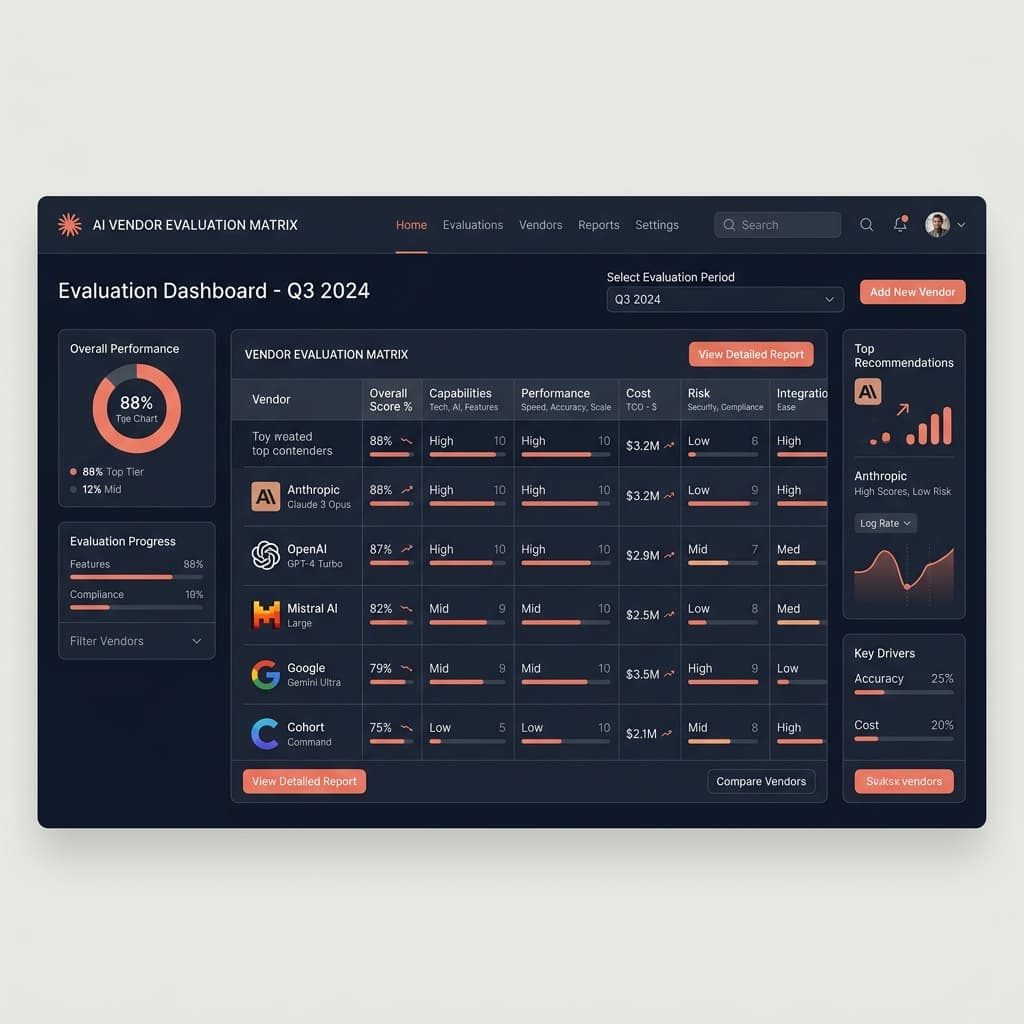
Every week, CTOs walk into scoping calls with Seven Labs after burning six figures and six months on the wrong AI development agency. The pattern is consistent: a vendor pitched impressive demos, signed a contract, delivered a brittle prototype, and disappeared when production problems surfaced. This guide is the AI vendor selection framework they wished they had at the RFP stage.
Can Your Internal Engineering Team Actually Build This?
Probably not at the speed or quality you need. Hiring specialized ML engineers, data pipeline architects, and LLM security experts takes three to five months in the current market [Source: LinkedIn Talent Insights 2025]. By the time your internal team ships V1, the underlying foundation models will have changed twice, and your engineers will have spent a full quarter solving problems that specialized AI outsourcing partners have already solved.
The real cost is not salaries. It is opportunity cost. Every sprint your senior engineers spend fighting vector database configurations and embedding pipeline edge cases is a sprint they are not working on your core product. Based on Seven Labs' engagements across 50+ AI projects, companies that attempt full in-house builds without a specialist partner spend an average of 40% more time reaching production-grade reliability than those who partner from the scoping phase.
"The organizations that move fastest are not the ones with the biggest internal ML teams. They are the ones that know exactly which components to own and which to delegate to partners with battle-tested infrastructure." - Faisal Al-Rashid, CTO, Fintech Group (Gulf Region)
The intellectual property is not the API integration. It is your proprietary data and the specific workflows you optimize. A specialized AI development agency builds the infrastructure in weeks, trains your internal team on the architecture, and hands over a documented codebase your engineers can maintain confidently.
What Happens to a Working Prototype When It Hits Real Production Data?
It collapses. Building an AI prototype takes 48 hours. Taking that prototype to enterprise production takes four months of rigorous backend engineering. The chasm between these two phases is where most AI project failures occur, and most AI agencies do not know how to cross it.
A system that works perfectly on five clean PDF documents will fail catastrophically when fed 50,000 messy, real-world enterprise contracts. Context windows overflow. Retrieval accuracy drops. Response latency spikes. Default vector database parameters that handle 10,000 embeddings will destroy query performance at 10 million embeddings [Source: Pinecone Engineering Blog, 2025].
When vetting an AI vendor, demand a detailed explanation of their chunking strategy. Naive character-count chunking on complex tabular data produces retrieval failures at scale. Based on Seven Labs' engagements, structural chunking combined with hybrid semantic and keyword search maintains accuracy above 90% even at millions of vectors. If a vendor cannot describe their indexing strategy in concrete engineering terms, they are selling you a proof-of-concept dressed as a production system.
Which Red Flags Should I Watch for During an AI Vendor RFP?
The clearest red flag in AI agency evaluation is a vendor that pitches features before architecture. Production-grade AI development agencies lead with security boundaries, data pipelines, and compliance requirements. Vendors who open with chat interface demos and "intelligent automation" are building toys, not enterprise systems.
Based on Seven Labs' VAPT engagements, we have audited AI systems built by well-funded agencies that were silently leaking personally identifiable information into public foundation models. The root cause was always the same: no zero-trust boundaries, no role-based access control on the RAG pipeline, and no security architecture review at the scoping phase. The client lost eight months of progress and had to rebuild from scratch.
Use the table below as your AI agency evaluation checklist for every RFP and scoping conversation.
| Red Flag | What It Signals | What to Ask Instead |
|---|---|---|
| Pitches features before asking about your data architecture | Vendor lacks production engineering depth | "Walk me through your RAG pipeline security model." |
| Cannot explain chunking or retrieval strategy | Will fail at scale with real enterprise data | "How do you handle structured vs. unstructured document types?" |
| Suggests a public cloud deployment without asking about data residency | Ignores compliance requirements | "Where exactly does context assembly happen relative to our firewall?" |
| Proposes standard unit tests for LLM outputs | Does not understand probabilistic model behavior | "Show me your LLM evaluation pipeline and golden dataset methodology." |
| Quotes a development fee with no mention of inference costs | Hidden long-term costs will surface post-launch | "Model the monthly API cost at our expected token volume." |
| Delivers slide decks as technical documentation | Cannot produce verifiable engineering artifacts | "Provide the architecture diagram and a sample CI/CD pipeline spec." |
| Uses heavy, opaque orchestration frameworks without explanation | Creates abstraction lock-in and unmaintainable technical debt | "Can we swap the underlying model without rewriting the core application?" |
How Do I Protect Sensitive Data When Outsourcing AI Development?
Demand VPC deployment and zero-touch data handling before any contract is signed. Enterprise AI is primarily a data security problem; the generative model is just the computation layer on top. A serious AI development partner asks about air-gapped requirements, data residency constraints, and SOC 2 compliance mandates before they ever mention model selection.
For Gulf enterprise clients, data sovereignty is non-negotiable. A vendor who suggests a default US-based cloud deployment without discussing regional infrastructure is not conducting AI project scoping at an enterprise level. Seven Labs deploys all client systems within the client's own virtual private cloud. Model weights may be external, but execution and context assembly happen strictly behind the client's firewall.
If a partner asks for production database dumps to "train their models," end the conversation. Mature AI development agencies use synthetic data generation for testing and rely on secure embedding pipelines that never expose raw records to external systems. Ask specifically how PII is handled at ingestion, during embedding, and in retrieval responses.
"Security architecture in an AI system is not a feature you add at the end. It is a constraint that shapes every design decision from the first day of scoping." - Dr. Sara Khalid, Head of AI Governance, Regional Banking Consortium
What Does Vendor Lock-In Actually Look Like in an AI Contract?
Lock-in operates at three distinct layers: model, infrastructure, and abstraction. Understanding all three before signing a Master Services Agreement is the difference between a system your engineers can own and a system that holds your data hostage.
Model lock-in occurs when a vendor hardcodes prompts tuned exclusively to one model's formatting quirks. When that model is deprecated or a cheaper alternative emerges, rewriting the core application costs as much as the original build. Demand a model-agnostic abstraction layer that allows swapping between providers without core application changes.
Infrastructure lock-in occurs when the vendor builds proprietary wrappers around your deployment environment without providing Terraform scripts or open-source orchestration tooling. You must own the deployment state. Obfuscated infrastructure is a hostage tactic.
Abstraction lock-in is the most common issue Based on Seven Labs' engagements when rescuing failed AI projects. Heavy, opaque orchestration frameworks become unmaintainable after 12 months of model and dependency updates. Seven Labs replaces these with lightweight custom routers that are readable by any senior engineer on your team.
Any AI outsourcing partner worth hiring builds a system you can hand directly to your internal engineers on day one of post-launch.
How Should AI Systems Be Tested Before Enterprise Deployment?
Standard unit tests do not work for large language models. Language models are probabilistic: they produce different outputs for identical inputs. A traditional software agency that writes assertion-based unit tests for an LLM application is shipping blind.
Production-grade AI development agencies build continuous evaluation pipelines. They generate hundreds of synthetic user queries, automatically score LLM responses for relevance, toxicity, and hallucination rate, and run these evaluations on every commit. 70% of AI production incidents traced in a 2025 study were caused by model drift after upstream provider updates, not by application code bugs [Source: MIT Sloan Management Review, AI Reliability Report 2025].
Ask vendors specifically about their LLM-as-a-judge implementation and their retrieval augmented generation assessment metrics. Demand to see an incident response playbook for upstream API outages. Does the system have fallback models configured? Does it queue requests during degradation, or does the user receive a raw 500 error? A vendor without documented answers to these questions is not ready for your production environment.
What Engineering Deliverables Should I Demand Before Signing?
Stop accepting slide decks as proof of capability. During AI project scoping, a production-ready partner delivers a documented architecture design, specific cloud cost projections with per-token math, and a written testing strategy before any development contract is signed.
Seven Labs' AI Platforms engagements begin with a formal architecture document, a cloud cost model based on your actual token volume estimates, and a CI/CD pipeline specification that benchmarks model precision against a golden dataset on every commit. If a vendor cannot produce these artifacts at the scoping stage, they cannot produce a reliable system at the launch stage.
Demand answers to these specific questions: How are embeddings updated when source documents change? Does the system perform a full re-index or use targeted upserts? What is the cache invalidation strategy for the RAG pipeline? What is the fallback when the primary model provider experiences degraded performance? Vague answers to concrete engineering questions are the clearest signal that you are evaluating the wrong partner.
Frequently Asked Questions: AI Vendor Selection
How long should AI project scoping take before a development contract is signed?
Based on Seven Labs' engagements, a rigorous scoping phase for an enterprise AI system takes two to four weeks. It should produce a written architecture document, cloud cost model, data security plan, and testing strategy. Vendors who push to skip scoping and move directly to development are prioritizing their revenue over your project's success.
What is a reasonable timeline to expect from a qualified AI development agency?
A production-grade AI agent or RAG pipeline should reach initial enterprise deployment in 10 to 20 weeks, depending on data complexity and compliance requirements. Seven Labs has delivered AI agents to production in 18 days for well-scoped engagements with clean data pipelines. Vendors promising full enterprise deployment in under two weeks without a completed scoping phase are setting unrealistic expectations.
How do I evaluate an AI agency's actual production experience versus demo capability?
Request case studies that describe specific engineering decisions, not just outcomes. Ask about a project that failed or required a significant architecture pivot, and how the team responded. Agencies with genuine production experience can describe the exact failure modes they encountered with vector databases, context window management, or model versioning and explain how they resolved them.
What ongoing costs should I budget for after an AI system launches?
Inference costs, embedding model hosting, and vector database fees compound rapidly at scale. A qualified AI development partner will model these costs during scoping and design semantic caching layers to reduce redundant LLM calls by up to 40% [Source: Anthropic Engineering Blog, 2025]. Budget separately for quarterly model evaluations, which are required whenever your AI provider releases a new model version that may affect output quality.
If you are evaluating AI partners in the UAE, Gulf region, or Pakistan and want a technical scoping review before committing to a vendor, book a 30-minute call with Seven Labs. Our engagements start with architecture, not demos.