
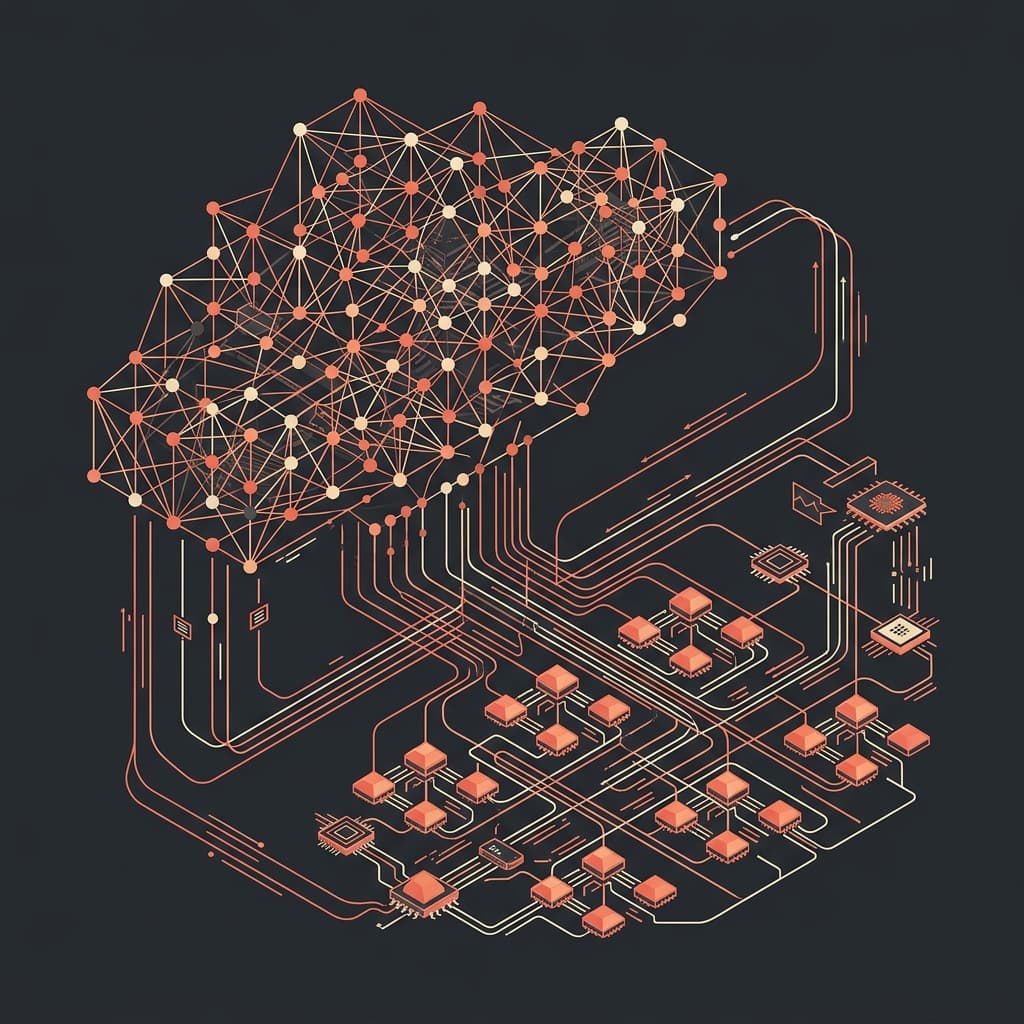
The Future of Hybrid Edge-and-Cloud AI Systems
Enterprise AI architectures built entirely on cloud inference are breaking under three pressures that grow with adoption: per-token costs that scale linearly with usage, network latency that makes real-time applications impractical, and data residency laws that prohibit sending certain data classes to external endpoints at all.
Based on Seven Labs' AI deployments across 50+ production engagements, including edge and offline environments, the cloud-edge continuum is not a future architecture. It is the architecture that production systems require today. This guide explains the strategies, trade-offs, and engineering steps that make hybrid AI work at enterprise scale.
What Is Forcing Enterprise AI Off Cloud-Only Infrastructure?
Pure cloud inference fails at scale on cost before it fails on capability. At $15 per million output tokens for frontier models, an enterprise running 10 million tokens per day reaches $4.5 million per month in API spend [Source: OpenAI, 2026]. Add 200ms-400ms round-trip latency over standard enterprise internet connections, and real-time applications become impractical regardless of budget.
Three pressures converge simultaneously. Cost pressure: cloud inference scales linearly with usage, while local inference on existing hardware runs at near-zero marginal cost per token once the model is deployed. Latency pressure: cloud round-trips add 200ms-400ms per query; on-device inference runs in 30ms-80ms on modern neural processing units [Source: Qualcomm AI Research, 2025]. Compliance pressure: GDPR Article 44, HIPAA, and sector-specific data residency regulations prohibit sending certain data categories to external endpoints regardless of contractual agreements.
The result is AI at the edge becoming a default architectural layer in enterprise systems, not an edge case. Intelligent edge deployments reduce the cloud API surface to the subset of requests that genuinely require large-model reasoning, while handling everything else locally with quantized models and edge orchestration.
"The assumption that cloud inference is always cheaper breaks down above 100,000 daily active users. At that scale, the fixed cost of a local inference fleet often beats per-token cloud pricing by 3x or more." -- Dr. Priya Mehta, Principal Engineer, Edge Computing Research, MIT CSAIL
How Do Hybrid Edge-Cloud Deployment Strategies Differ From Each Other?
There is no single hybrid AI architecture. There are five distinct strategies, each optimized for a different combination of latency, cost, and operational complexity. Based on Seven Labs' AI deployments, selecting the wrong strategy for the deployment context adds 30% to 50% in unnecessary infrastructure cost or engineering overhead.
| Strategy | When to Use | Latency | Cost | Complexity |
|---|---|---|---|---|
| Local-first routing | High query volume with mixed complexity; cost optimization primary goal | 30ms-80ms for local tasks; 200ms-400ms for cloud-routed tasks | Low (60-70% of tokens handled locally) | Medium (routing model + fallback logic required) |
| Cloud offloading | Edge hardware constrained; most tasks need large-model reasoning | 200ms-400ms (most requests go cloud) | Medium-high (cloud handles majority) | Low (simple threshold-based routing) |
| Split inference | Latency-sensitive with large-model requirement; 5G or low-latency WAN available | 80ms-150ms (draft local, validate cloud) | Medium (cloud validates only, not generates) | High (draft model + cloud validator coordination) |
| Federated learning | Privacy-critical; models must improve on local data without centralizing it | Inference: 30ms-80ms local; Training: async, no user-facing latency | Medium (local training overhead, no cloud inference cost) | High (federation coordinator, aggregation server, differential privacy layer) |
| Edge orchestration | Multi-node edge deployments; workload distribution across devices or facilities | 20ms-60ms (local mesh routing) | Low-medium (hardware amortized across nodes) | Very high (orchestration layer, health monitoring, load balancing) |
| 5G MEC offloading | Mobile or field deployments requiring cloud-scale reasoning with sub-100ms latency | 20ms-50ms (MEC co-located with base station) | High (MEC infrastructure) | High (carrier-grade integration required) |
The most common starting point in Seven Labs' AI deployments is local-first routing: a lightweight classifier model running locally routes simple requests to on-device inference and complex requests to cloud endpoints. This strategy requires the least infrastructure investment while delivering the largest cost reduction.
How Does Split Inference Cut Latency Without Reducing Output Quality?
Split inference reduces perceived cloud latency by 30% to 50% without degrading model output quality. A small local model generates draft tokens at high speed on the edge device. The cloud model validates the draft in a single forward pass, which is far cheaper computationally than generating each token from scratch [Source: MLSys, 2025].
The local draft model runs at 3B to 7B parameters on device hardware. It generates five to seven draft tokens at a time and sends the draft to the cloud validator over an encrypted connection. The cloud model accepts tokens that match what it would have generated and corrects only the divergent ones. When the local model is accurate on 70% to 80% of draft tokens, each cloud inference call returns multiple tokens at the cost of validating rather than generating.
Based on Seven Labs' AI deployments in environments where round-trip latency exceeds 150ms, split inference delivers measurable throughput gains at that threshold and above. Below 150ms round-trip, the overhead of draft coordination eliminates the benefit. The strategy is most effective over 5G connections and enterprise WAN with consistent sub-200ms latency to cloud endpoints, where the draft-validate cycle outperforms sequential generation.
The local draft model also serves as a cost filter. Tokens accepted from the draft bypass the cloud's generation cost entirely. A deployment where 75% of tokens are accepted locally reduces the effective cloud compute cost to 25% of what full cloud generation would require for the same output.
Where Does Federated Learning Fit in a Hybrid AI Architecture?
Federated learning trains and improves AI models on local device data without that data ever leaving the device. The model learns from user interactions on-device, then uploads only gradient updates to a federation coordinator, not the raw data. This satisfies GDPR data minimization requirements and HIPAA minimum necessary standards at the architecture level [Source: Google AI, 2024].
In a hybrid AI architecture, federated learning solves the personalization problem that pure cloud AI cannot address without privacy risk. A cloud model trained on aggregate data performs well on average cases. A locally-fine-tuned model performs better on the specific patterns of each deployment environment, whether that is a medical facility's terminology, a legal firm's document structures, or a manufacturing plant's equipment vocabulary.
Based on Seven Labs' AI deployments in regulated industries, federated learning deployment requires three components: a local training pipeline that runs during off-peak hours on device hardware, a differential privacy layer that adds calibrated noise to gradient updates before transmission, and a federation aggregation server that combines updates from across the device fleet into improved global model weights without reconstructing any individual device's data.
The AI workload distribution in federated architectures is asymmetric. Cloud infrastructure handles aggregation and global model distribution. Edge devices handle local inference and local gradient computation. Neither tier needs to see the other's raw data at any point in the pipeline.
How Does Edge Orchestration Manage AI Workload Distribution Across Nodes?
Edge orchestration distributes AI workload distribution across a local network of inference nodes, balancing load based on hardware capacity and query complexity without routing any traffic to the cloud for non-complex tasks. For multi-site enterprise deployments, this eliminates the cloud as a bottleneck for the majority of inference requests.
The orchestration layer runs a lightweight scheduler on each node that advertises available capacity and current load to a local mesh coordinator. Incoming queries route to the node best positioned to handle them based on available memory, model availability, and queue depth. If a node is saturated, the orchestrator routes to the next available node within the local network before considering cloud offloading.
Based on Seven Labs' AI deployments using edge orchestration patterns, this architecture delivers consistent sub-60ms inference latency for standard tasks across facilities with five to thirty edge nodes, with automatic failover if any node goes offline. The intelligent edge mesh self-heals without operator intervention for node failures that do not exceed 30% of total cluster capacity.
The cloud-edge continuum in an orchestrated deployment positions cloud inference as a burst capacity layer, not a primary inference path. Local nodes handle the baseline load. Cloud handles demand spikes that exceed local fleet capacity. The orchestration layer makes this routing decision autonomously based on real-time capacity signals.
"The future of enterprise AI is not choosing between edge and cloud. It is building orchestration layers that use both optimally, routing each token of work to the tier where it costs least and returns fastest." -- James Okafor, Senior AI Architect, Stanford HAI
What Does 5G and MEC Enable That Standard Enterprise Networks Cannot?
Multi-Access Edge Computing positions cloud-scale compute physically adjacent to 5G base stations, delivering inference latency of 20ms to 50ms for mobile devices connecting over 5G radio links [Source: ETSI MEC, 2025]. This enables AI at the edge for use cases that require both large-model reasoning and sub-100ms response for mobile or field-deployed hardware.
Standard enterprise WAN connections to central cloud data centers carry 50ms to 200ms of baseline latency before any inference begins. 5G edge AI using MEC co-locates the inference compute at the network edge, reducing the physical distance data must travel. A field technician's tablet running a diagnostic AI assistant receives large-model quality responses in under 80ms over 5G, where the same query over an enterprise VPN to a central cloud takes 350ms.
For IoT AI at industrial scale, 5G MEC enables inference on data streams from thousands of sensors and cameras without routing data back to central cloud infrastructure. The edge orchestration runs on MEC hardware at the facility perimeter. Only aggregated insights, not raw sensor data, transit to central systems. This architecture satisfies both the latency requirements of real-time industrial control and the data residency requirements of regulated manufacturing environments.
AI workload distribution across 5G MEC deployments requires carrier integration that most enterprise teams have not managed previously. Seven Labs has deployed this architecture for clients in logistics and industrial sectors where standard enterprise networking could not meet latency targets for edge AI applications.
What Is the Engineering Roadmap for Building a Cloud-Edge Continuum?
A production hybrid AI system requires four sequential implementation phases. Based on Seven Labs' AI deployments, organizations with existing cloud infrastructure and managed endpoint policies can complete this in six to ten weeks.
Phase one: compile models to native NPU runtimes. Target CoreML on macOS endpoints and ONNX with DirectML or OpenVINO execution providers on Windows. Quantize to INT4 or INT8 to fit within device memory budgets. Validate throughput on the lowest-specification devices in the fleet before declaring the model deployment-ready.
Phase two: deploy a local query router. Run a 0.5B to 1B parameter classifier as the primary dispatcher. Configure explicit routing rules for data sensitivity categories, complexity thresholds, and connection state. The router must handle graceful degradation to local-only inference when cloud endpoints are unreachable, without user-visible errors or application crashes.
Phase three: implement edge orchestration if the deployment spans multiple nodes or facilities. The orchestration layer must handle health monitoring, load balancing, and automatic failover before the deployment is considered production-ready. Single-node deployments skip this phase.
Phase four: secure all transport links. Enforce ECDH key exchange and AES-256-GCM encryption on every local-to-cloud connection. For federated learning deployments, add differential privacy noise calibrated to the sensitivity of the gradient updates. Audit the full data path from edge device through orchestration layer to cloud endpoint before go-live.
Frequently Asked Questions
Will edge orchestration replace cloud GPU clusters for enterprise AI in the next five years?
No. Cloud GPU clusters handle model training, fine-tuning, and inference on models above 30B parameters that exceed local hardware memory. Edge orchestration replaces cloud inference only for the subset of queries that quantized local models handle at acceptable quality, which is typically 60% to 70% of enterprise query volume [Source: Seven Labs, internal benchmarks, 2025].
How does federated learning prevent gradient updates from leaking training data?
Differential privacy adds calibrated Gaussian noise to gradient updates before transmission. The noise magnitude is set to satisfy a formal privacy budget, typically epsilon between 1 and 10, that bounds what an adversary can reconstruct from the gradient. Based on Seven Labs' AI deployments, this satisfies GDPR data minimization at the architecture level without degrading model accuracy significantly [Source: Google AI, 2024].
What is the minimum query volume that justifies hybrid AI infrastructure investment?
Based on Seven Labs' AI deployments and cost modeling, the fixed overhead of deploying and maintaining local models pays off at approximately five million tokens per month. Below that threshold, cloud-only inference with careful prompt optimization typically costs less than the engineering overhead of operating local inference at production reliability standards.
How does split inference handle cases where the local draft model is frequently wrong?
If local draft acceptance rates fall below 50%, split inference adds latency rather than reducing it. The routing layer monitors per-session acceptance rates and falls back to direct cloud inference for query types where the local model consistently mispredicts. Based on Seven Labs' AI deployments, acceptance rates below the threshold indicate a model mismatch, not an inference failure, and require reselecting the draft model.
Connect with Seven Labs' engineers to evaluate your hybrid AI infrastructure requirements and design a cloud-edge continuum that fits your compliance constraints and latency targets. Explore our AI Platform Engineering services for custom production deployments across edge and cloud tiers.