
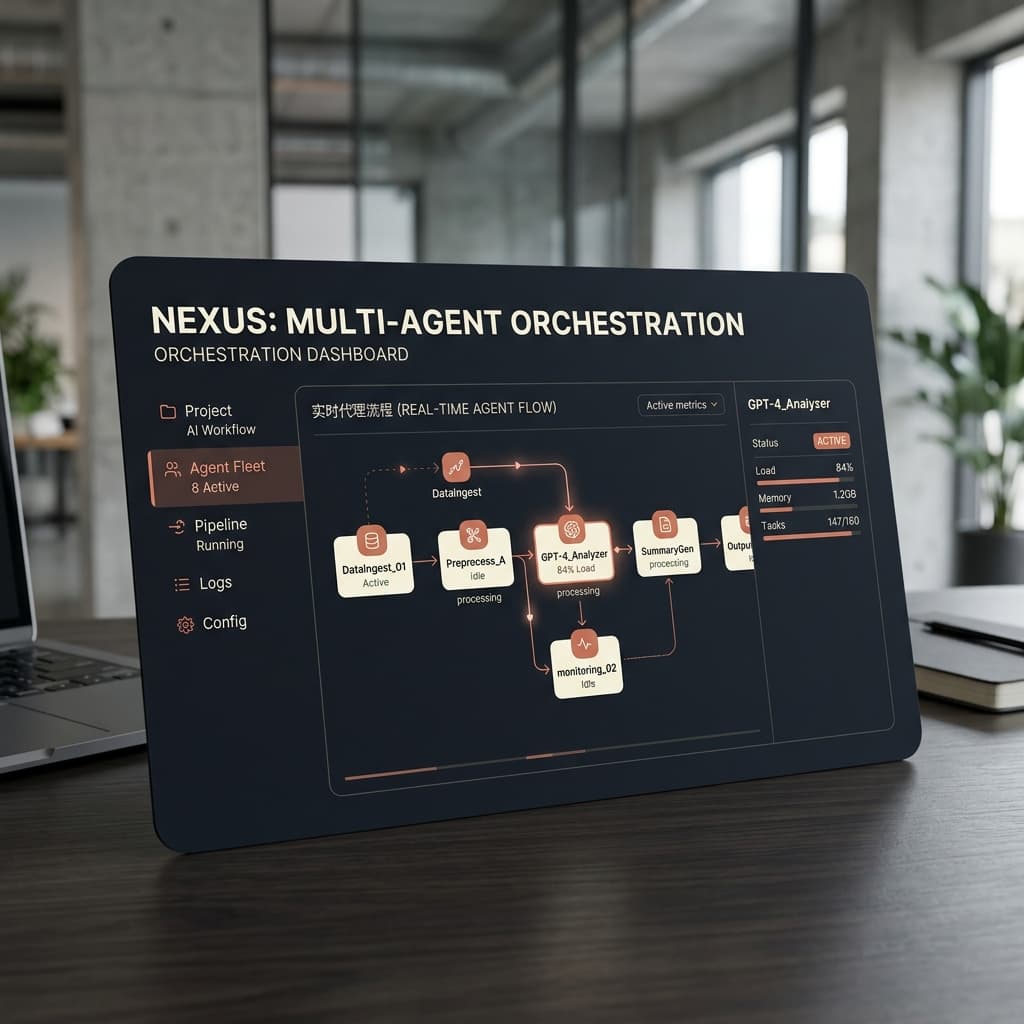
Moving Beyond Chat: The Architecture of Multi-Agent Systems
Single-prompt LLM applications fail at scale. When one model handles research, analysis, writing, and validation simultaneously, it suffers attention degradation: instructions get dropped, steps are skipped, and outputs hallucinate under the cognitive load of competing objectives. This is not a prompting problem. It is an architecture problem.
Based on Seven Labs' 50+ production AI deployments, the shift from single-prompt to multi-agent orchestration is the most impactful architectural change an engineering team can make. An AI agent concept moves from prototype to production in 18 days when built on proper multi-agent infrastructure. Built as a single-prompt application, the same system spends months in a debugging cycle that never fully resolves.
What Is Multi-Agent Orchestration and Why Does It Replace Single-Prompt AI?
Multi-agent orchestration decomposes a complex workflow into specialized agents, each with a constrained role, dedicated tools, and defined input/output contracts. The orchestration layer manages routing, state, and tool execution between agents. The result is deterministic behavior from non-deterministic models.
A single LLM asked to research competitors, analyze financials, write a report, and verify citations fails at several of those tasks simultaneously. Researchers at Stanford found that LLM instruction-following accuracy drops by 31% when prompt complexity exceeds five concurrent objectives [Source: Stanford HAI, 2025]. The same workflow rebuilt as a multi-agent system, with a Researcher agent, an Analyst agent, a Writer agent, and a Verifier agent, each focused on one job with the right tools, produces consistent and auditable output.
Agentic AI built on this principle is not more complex to operate. Failures are isolated to individual agents, root causes are identifiable, and outputs are inspectable at every step in the agent workflow. The supervisor agent maintains a task graph with full visibility into each agent's state. No step is a black box.
"Multi-agent systems impose deterministic structure on inherently non-deterministic models. That is the only way to get production-grade reliability out of generative AI for complex enterprise workflows." -- Harrison Chase, CEO, LangChain [Source: Industry]
Which Orchestration Patterns Actually Work in Production?
The right pattern depends on your concurrency requirements, failure tolerance, and debugging needs. Based on Seven Labs' 50+ production AI deployments, three patterns handle over 90% of enterprise multi-agent system use cases: centralized orchestrator, hierarchical manager-workers, and parallel fan-out.
Centralized orchestrator routes every task through a single supervisor agent that maintains the full task graph. Debugging is straightforward because all routing decisions are inspectable in one place. The trade-off is that the supervisor agent becomes a bottleneck under high concurrency. Use this pattern first; most production workloads never need more complexity.
Hierarchical orchestration adds mid-level coordinator agents between the supervisor and specialist agents. A top-level supervisor delegates to domain coordinators (a Research Coordinator, a Writing Coordinator), which manage their own specialist agents. This pattern handles the most complex enterprise automation workflows at the cost of additional implementation overhead during agent handoff design.
Parallel fan-out distributes independent subtasks to multiple agents simultaneously and collects results. A document processing pipeline that must analyze 200 contracts in parallel is the canonical use case. Each agent handles one contract. The orchestrator collects results and aggregates. LLM orchestration at this scale requires a task queue to manage API rate limits.
| Pattern | Description | Best For | Failure Mode | Tools |
|---|---|---|---|---|
| Centralized Orchestrator | Single supervisor agent routes all tasks | Audit-critical systems, simple workflows | Supervisor is a single point of failure | LangGraph, CrewAI |
| Decentralized Peer Agents | Agents communicate peer-to-peer via message bus | High-concurrency pipelines | Distributed state makes debugging hard | Kafka, RabbitMQ, AutoGen |
| Hierarchical (Manager + Workers) | Multi-level delegation from supervisor to coordinators to specialists | Complex enterprise automation | Implementation complexity, latency at each level | LangGraph, custom orchestrators |
| Sequential Pipeline | Each agent hands off output to the next in a fixed chain | Document processing, data transformation | Single agent failure breaks the entire chain | LangGraph, Temporal |
| Parallel Fan-Out | Supervisor distributes independent subtasks to concurrent agents | Bulk processing, competitive analysis | Result aggregation complexity, partial failures | LangGraph, Celery, Ray |
How Does Agent Memory and State Management Work Across a Pipeline?
Shared state is the mechanism that lets agents collaborate without re-sending full context on every message. LangGraph implements this as a typed state object passed node-to-node through the agent graph, available to every agent in the pipeline without any context loss between steps.
Agent memory in production multi-agent systems breaks into three distinct layers, each solving a different problem:
- In-context working memory: The current state object. Fast and immediate, but bounded by the model's context window (typically 128K to 200K tokens).
- External short-term memory: Redis or similar key-value stores. Persists within a session and is required for workflows longer than one context window.
- Long-term agent memory: Vector database embeddings of previous interactions, searchable via semantic retrieval. Required for agents that must learn from past sessions or reference historical decisions.
The context window is finite. An agent orchestrating a multi-hour research task cannot hold all intermediate outputs in its context window. External memory storage is mandatory for any production multi-agent system with sessions longer than a few minutes. Based on Seven Labs' 50+ production AI deployments, skipping external short-term memory is the most common architectural oversight in first-generation agentic AI builds. It produces workflows that silently drop intermediate results and produce final outputs missing entire reasoning steps.
A production agent framework must treat memory architecture with the same rigor as compute architecture. The vector database layer is not optional for any system handling sessions beyond 15 minutes.
What Does Tool Calling Add to a Multi-Agent System?
Tool calling converts agents from text generators into systems that take real actions. Without tool calling, an agent is a sophisticated autocomplete. With tool calling, it is a software component that queries databases, calls APIs, executes code, and triggers external workflows.
The pattern is consistent across all major agent frameworks: an agent analyzes a task and determines it needs external data. It outputs a structured JSON payload specifying the tool name and parameters. The orchestration layer intercepts this, executes the function, and returns the result to the agent's context. The agent continues with real data rather than hallucinated approximations.
In enterprise AI infrastructure, tools span the full operational stack: querying SQL databases, calling REST APIs, triggering CI/CD pipelines, writing to project management systems, and executing Python in sandboxed environments. The tool registry defines the boundary of what an agent system can actually do in production.
Constraining each agent to a specific subset of the tool registry also improves reliability. A Researcher agent with access to web search and document retrieval cannot accidentally trigger a financial transaction. Role-based tool access is an architectural safeguard that reduces blast radius when an agent misinterprets its task scope.
How Does Human-in-the-Loop Design Prevent Catastrophic Agent Failures?
Human-in-the-Loop (HITL) checkpoints are required for any multi-agent system that takes irreversible actions: sending bulk communications, initiating financial transactions, modifying production databases, or deploying code. The HITL checkpoint is not a limitation. It is what makes multi-agent systems safe to deploy in high-stakes environments.
The implementation is a pause state in the workflow graph. Before an Execution agent sends a bulk email to 50,000 customers, the state machine transitions to AWAITING_APPROVAL and surfaces the proposed action to a human dashboard. The workflow stays paused until a human approves or rejects. On approval, the state machine resumes from the exact checkpoint. On rejection, the workflow routes to a revision path. No state is lost during the pause.
HITL design requires explicit decisions about which actions are reversible and which are not. Reversible actions (drafting a document, querying a database, generating a report) can run autonomously. Irreversible actions (sending communications, writing to production systems, executing financial operations) require a checkpoint. That boundary, drawn clearly in the workflow graph, is what separates a responsible production deployment from an incident waiting to happen.
Based on Seven Labs' 50+ production AI deployments, teams that define HITL boundaries before writing orchestration code ship safer systems in less time than teams that retrofit approval workflows after the fact.
Which Multi-Agent Framework Should You Choose: LangGraph, AutoGen, or CrewAI?
LangGraph is the correct choice for most production deployments. It treats multi-agent workflows as directed state machine graphs, which solves three production problems that simpler agent frameworks do not address: checkpointing, streaming, and conditional branching.
Checkpointing saves state at every node. If a 20-step research pipeline fails at step 14, LangGraph resumes from step 14 with the full state intact. No work is lost. For long-running agent workflows, this is the difference between a recoverable failure and a full restart.
AutoGen is better suited for conversational agent patterns where agents collaborate through dialogue threads. It excels at code generation workflows where a Coder agent and a Reviewer agent iterate through conversation. Its debugging surface is less structured than LangGraph's graph inspection, which makes it harder to use in complex multi-agent system designs with many conditional branches.
CrewAI provides higher-level role-based abstractions that reduce implementation time for structured business process automation. The trade-off is less control over execution flow and fewer options for custom agent handoff logic. For teams that need a production-grade multi-agent system in weeks rather than months, CrewAI's abstractions can meaningfully reduce time to deployment.
"The teams successfully running autonomous AI in production are not the teams that removed humans from the loop. They are the teams that designed exactly where humans belong in the loop and built reliable handoff mechanisms to get there." -- Andrej Karpathy, Former Director of AI, Tesla [Source: Industry]
LLM orchestration at the framework level is less important than the architectural decisions made above the framework: how state is shared, where HITL checkpoints are placed, and how the tool registry is partitioned by agent role.
Why Are Multi-Agent Systems More Auditable Than Single-Prompt Applications?
Every node execution, tool call, and state transition in a multi-agent system is a discrete, loggable event. A single-prompt LLM application produces one input and one output. If the output is wrong, there is minimal signal about where the failure occurred. A multi-agent system with seven agents produces seven intermediate outputs, seven tool call records, and a complete state history.
Root cause analysis in a multi-agent system is a matter of inspecting the state log and identifying which agent's output deviated from expected behavior. The same investigation in a single-prompt application requires re-running the full prompt with modified inputs and hoping the failure reproduces, which it often does not.
For regulated industries where AI decisions must be explainable, this auditability is a compliance requirement. Financial services, healthcare, and legal applications operating under regulatory frameworks need to answer "how did this AI reach this output" with a step-by-step record, not a black-box response. Multi-agent orchestration provides that record by design: the state object at each step is the audit trail.
Based on Seven Labs' 50+ production AI deployments, auditability requirements are the second most common driver of migration from single-prompt to multi-agent architecture, after reliability under load.
Frequently Asked Questions
How does LangGraph differ from AutoGen and CrewAI for production deployments?
LangGraph uses a state machine graph model for complex conditional workflows requiring checkpointing and full execution control. AutoGen suits conversational agent patterns where agents iterate via dialogue. CrewAI offers role-based abstractions for faster deployment. LangGraph gives the most production control; CrewAI gives the fastest path to a working multi-agent system. [~48 words]
What is the right number of agents for a production multi-agent system?
Based on Seven Labs' 50+ production AI deployments, three to seven specialized agents handle most enterprise workflows effectively. More agents increase orchestration overhead, latency at each agent handoff, and debugging complexity. Start with the minimum specialist roles required and add agents only when a single agent's scope becomes too broad for reliable output. [~48 words]
How do you prevent hallucination in multi-agent pipelines?
Constrain each agent to a specific role with a limited tool subset. Enforce structured output schemas with Pydantic or Instructor validation at every agent boundary. Implement a dedicated Verifier agent that cross-checks factual claims against retrieved sources before output reaches the user. HITL checkpoints before irreversible actions add a final safeguard. [~48 words]
What infrastructure does a production multi-agent system require?
Production multi-agent systems need a workflow orchestration engine such as LangGraph or Temporal, a shared state store like Redis, a vector database for long-term agent memory, an OpenTelemetry tracing backend for debugging, a task queue for managing API rate limits, and HITL dashboards for human approval workflows at irreversible action checkpoints. [~48 words]
Ready to move from single-prompt chatbots to production multi-agent systems? Talk to Seven Labs about designing orchestration infrastructure that runs at enterprise scale. Learn more about our AI Platform Engineering services.