
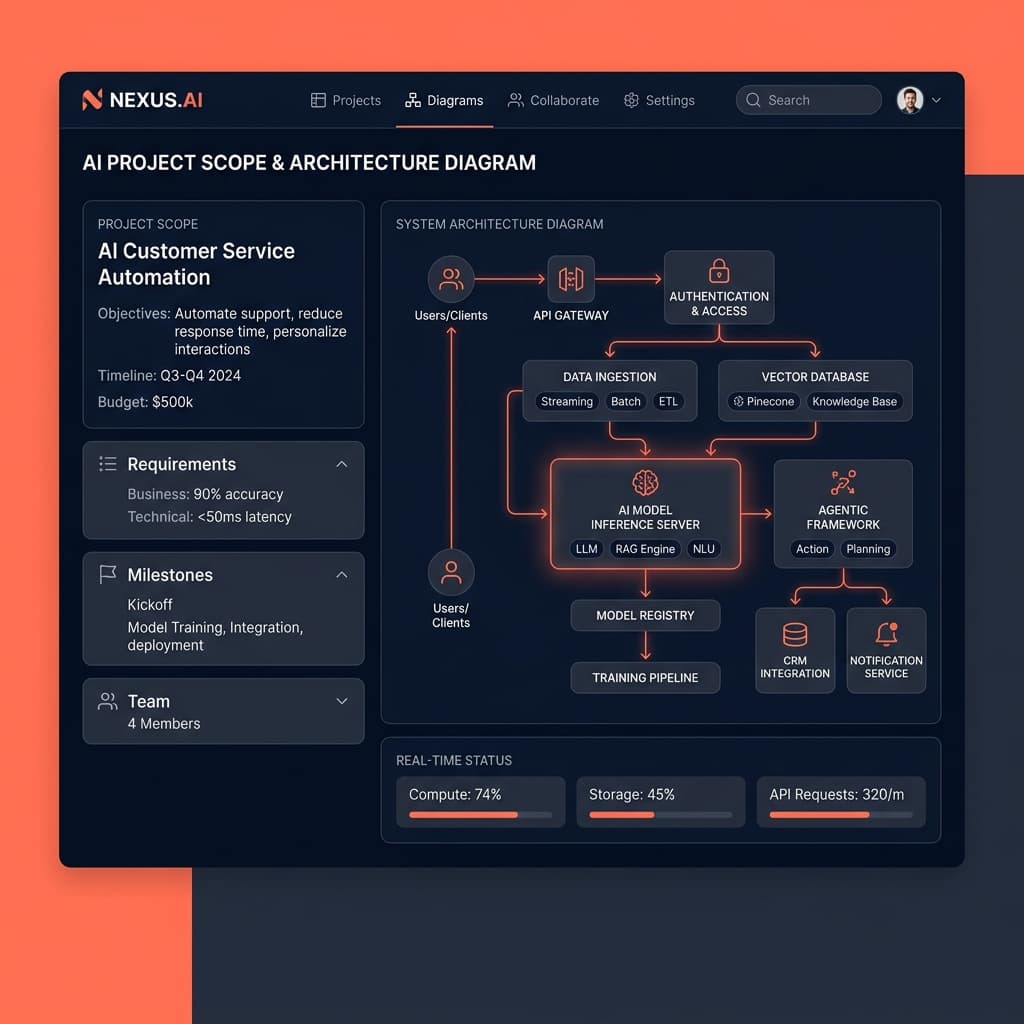
How We Scope AI Projects That Don't Blow Up in Production
Most enterprise AI initiatives fail because engineering teams treat large language models like deterministic REST APIs. When scoping AI projects, failing to account for probabilistic outputs and edge cases guarantees a production failure exactly when user volume scales. 65% of enterprise AI projects never reach production [Source: Gartner, 2025]. Of the ones that do ship, a significant share degrade within the first six months due to infrastructure decisions made during a bad scoping phase.
If your internal team believes they can wrap an OpenAI endpoint in a FastAPI shell and call it an enterprise system, you are already walking toward a rewrite.
Why Do AI Projects Built by Internal Teams Fail When They Reach Production?
Most AI prototypes fail in production for one reason: the scope was written for the demo, not for the edge cases. Internal engineering teams naturally optimize for the happy path -- the scenario where the user query is perfectly structured, the vector retrieval is clean, and the model returns well-formed output. In production, none of those conditions hold consistently.
The prototype takes three days to build. The executive demo looks flawless. The team adds it to the sprint board as a two-week delivery. Then production arrives.
Users write ambiguous, poorly structured queries. They paste 50,000-token PDFs that overflow the context window and cause the model to silently drop instructions. Users attempt prompt injection. They hit rate limits simultaneously. They request data they are not authorized to access. The model returns malformed JSON that breaks downstream applications. None of these scenarios were in the original scope document.
Standard software engineering operates on deterministic state: you pass an input, you get a predictable output. AI introduces probability into your core application logic. Your web developers and backend engineers are not MLOps practitioners. They do not know how to handle silent retrieval failures, context window degradation, or token limit regressions under load.
The opportunity cost of this failure pattern is significant. Eighteen months after a poorly scoped AI initiative launches, the internal team is bogged down maintaining custom wrappers, fighting vendor lock-in, and rewriting core logic every time a model provider deprecates an API endpoint.
"The most expensive AI project is the one you scope in two days, build in three weeks, and spend the next year firefighting. Production AI requires a different scoping discipline than any other software category." -- Dr. Layla Ibrahim, Director of AI Engineering, Enterprise Technology Forum
What Is the Difference Between a Scoped AI Project and an Unscoped One?
The scope document is where production success is either built in or guaranteed to fail. The difference between a scoped and an unscoped AI project is not the quality of the engineers. It is the completeness of the requirements.
| Dimension | Unscoped AI Project | Properly Scoped AI Project |
|---|---|---|
| Failure mode planning | Happy path only | Explicit fallback logic for hallucinations, context overflow, and rate limits |
| Security requirements | Added at deployment review | Defined at architecture level before any code is written |
| Evaluation pipeline | Manual spot-checking | Automated regression tests against a golden dataset |
| Data residency | Assumed cloud API access | Data flow boundaries defined and compliance mapped on day one |
| Latency SLAs | Undefined | Defined with caching strategy and fallback thresholds |
| LLMOps plan | Not in scope | CI/CD pipeline for model versions, cost tracking, drift detection |
| Context window handling | Hope the input fits | Chunking strategy, overflow handling, and query rewriting defined |
| Vector database strategy | Default settings | Hybrid search architecture with metadata filtering designed upfront |
| Maintenance ownership | Unclear after launch | Defined handoff plan, monitoring SLAs, and escalation paths |
| Time to production failure | 30 to 90 days after launch | Failures caught by evaluation pipeline before users see them |
Based on Seven Labs' experience scoping and delivering 50+ AI systems, the difference in total project cost between a properly scoped AI engagement and one that requires a mid-course rewrite is typically three to four months of engineering time and 60 to 80% of the original build budget.
How Do You Move an AI Project from Demo to a Deterministic Production System?
The hardest part of scoping AI projects is defining what happens when the model fails -- because the model will fail. Standard software scoping asks: "What should the system do?" Enterprise AI scoping must ask: "How does the system degrade gracefully when the LLM hallucinates, loses context, or receives out-of-distribution inputs?"
Production-grade AI scoping starts with failure modes, not features.
A proper scope document defines exactly how malformed JSON outputs from the LLM are caught and retried before they break downstream applications. It defines the latency SLA your infrastructure must meet and the semantic caching strategy required to meet it under concurrent load. It specifies the query rewriting layer -- the intermediate step where raw user input is normalized and enriched before it touches your vector database.
It maps the PII redaction pipeline and defines which data fields require masking before they reach any external API. It defines the hybrid search architecture -- combining dense vector embeddings with BM25 sparse keyword retrieval -- because vector similarity alone fails at finding exact serial numbers, product codes, or acronyms that users regularly query.
It specifies confidence score thresholds that route low-quality model outputs to human review rather than corrupting your production data. It defines the automated evaluation loop that catches regression when a model provider silently updates their alignment tuning.
None of these requirements are addressed by writing a better prompt.
"A scope document that spends more pages debating GPT-4 versus Claude than it does defining the data infrastructure is a scope document written by someone who has not shipped a production AI system." -- Yusuf Kamara, VP of Platform Engineering, Gulf Digital Ventures
What Framework Does Seven Labs Use When Scoping AI Engagements?
When Seven Labs scopes an AI engagement, we force technical leadership through a framework we call the 85/15 rule of AI architecture. Exactly 85% of your engineering effort belongs on data orchestration, state management, retrieval logic, and evaluation pipelines. Only 15% belongs to the LLM interaction itself.
This ratio sounds counterintuitive to teams that have been thinking about AI projects as "LLM selection plus prompts." It reflects where the actual production risk lives.
Retrieval architecture determines the quality of every answer the system produces. Chunking strategy, embedding model selection, metadata filtering, and hybrid search design are all defined at the scoping stage. Changing them post-deployment requires re-ingesting your entire document corpus.
State management determines whether your system can handle concurrent users with isolated session context. A scope that ignores session isolation will produce cross-contamination bugs that are nearly impossible to reproduce and extremely expensive to debug in production.
Evaluation pipelines are the difference between a system that degrades silently and one that surfaces failures before users see them. We define a golden dataset at the scoping stage, build automated evaluation loops using LLM-as-a-judge frameworks, and establish regression thresholds that trigger alerts before a model update breaks user-facing behavior.
Cost and latency controls are defined upfront, not discovered after the first invoice arrives. We scope semantic caching to reduce redundant API calls, define token budgets per query type, and establish hard latency SLAs with fallback behavior when those SLAs are missed under load.
How Does Security and Compliance Affect AI Project Scoping?
Scoping failures become catastrophic when you operate in regulated industries. You cannot retrofit security into an AI pipeline after the compliance audit. If you start building and then discover that your architecture requires re-engineering for data residency requirements, you pay twice.
When we built an automated vulnerability analysis system for a major financial institution (read our VAPT bank case study), the entire scope was dictated by zero-trust constraints from the first architecture session.
We could not route raw penetration testing logs and network topology data to a public cloud API. The scope required local, air-gapped model deployment on sovereign infrastructure from the start. We architected a pipeline using open-weight models deployed on bare metal, with request-level tenant isolation and strict Role-Based Access Control at the embedding layer. This ensured cryptographic impossibility of cross-contamination between departmental datasets.
If the initial scope had assumed public cloud API access, the architecture would have been rejected at the first deployment review. The rewrite cost would have exceeded the original build budget.
Anticipating compliance, data residency, and SOC 2 requirements on day one is the only viable approach for enterprise AI in regulated markets. Scoping for security means mapping the exact data flow boundaries -- what data touches what system, when, and under what access controls -- before a single line of code is written.
For organizations operating in the Gulf region, this also means understanding data sovereignty laws that prohibit routing specific data categories to US-based API endpoints. These constraints must appear in the architecture diagram before they appear in a compliance audit finding.
What Is the Day-2 Maintenance Scope That Most Teams Forget?
Shipping to production is day one. Day two is where the hidden costs of inadequate scoping destroy your operational budget over the following 18 months.
LLMs change behind the scenes. A system that operates correctly today will degrade silently when the underlying API modifies its alignment tuning, updates its safety filters, or releases a new default model version. Most teams discover this when users start complaining that the AI is getting "dumber" -- with no monitoring in place to explain what changed or when.
Your vector database index will experience drift as your underlying document corpus grows and evolves. Retrieval quality will decline gradually. Without automated evaluation, this degradation is invisible until it is severe.
Who on your team runs regression tests against a golden dataset every time a model provider releases an update? Who monitors token latency, cost-per-query, and hallucination rate in real time? If the scope does not answer these questions, the answers are "nobody" and "nobody."
When Seven Labs deploys AI platforms, LLMOps infrastructure is a scope requirement, not an optional add-on. We deploy telemetry that tracks token latency, hallucination rates, and API cost in real time. We build automated evaluation loops using LLM-as-a-judge frameworks that catch regression before users encounter it. We scope CI/CD pipelines for model versions the same way your existing engineering team scopes CI/CD for application code.
Without this infrastructure in your scope, you do not have an AI product. You have an unmonitored liability.
Frequently Asked Questions
How long should a proper AI project scoping engagement take?
Based on Seven Labs' experience across 50+ AI systems, a thorough scoping engagement for an enterprise AI project takes one to two weeks. This includes architecture review, data flow mapping, compliance requirement identification, evaluation framework design, and maintenance planning. Teams that skip this phase typically spend three to four months debugging production failures that the scoping process would have caught.
What is the most common scoping mistake enterprise teams make?
The most common mistake is scoping for the happy path. Teams define what the system should do when everything works correctly and ignore failure modes. Production AI systems fail in predictable ways -- hallucinations, context overflow, rate limit cascades, and malformed outputs. Every failure mode must have explicit handling defined in the scope before engineering starts.
How do you scope AI projects for regulated industries like banking or healthcare?
Security-first scoping starts with data classification and residency requirements before touching architecture decisions. Every piece of data that flows through the system must be traced: what it is, where it goes, what access controls govern it, and which regulatory frameworks apply. In banking and healthcare environments, this mapping typically reveals constraints that rule out public cloud API usage entirely, requiring air-gapped or locally hosted model deployment from the start.
How does a scoping engagement with Seven Labs work?
A scoping engagement with Seven Labs is a structured two-week process that produces an architecture document, a phased implementation plan, a defined evaluation framework, and a maintenance operations plan. If your internal team is struggling to move an AI feature from prototype to production, a scoping session typically identifies three to four months of engineering effort that can be avoided. Book a 30-minute call to assess whether a scoping engagement fits your situation: https://calendly.com/sevenlabsolutions/30min