
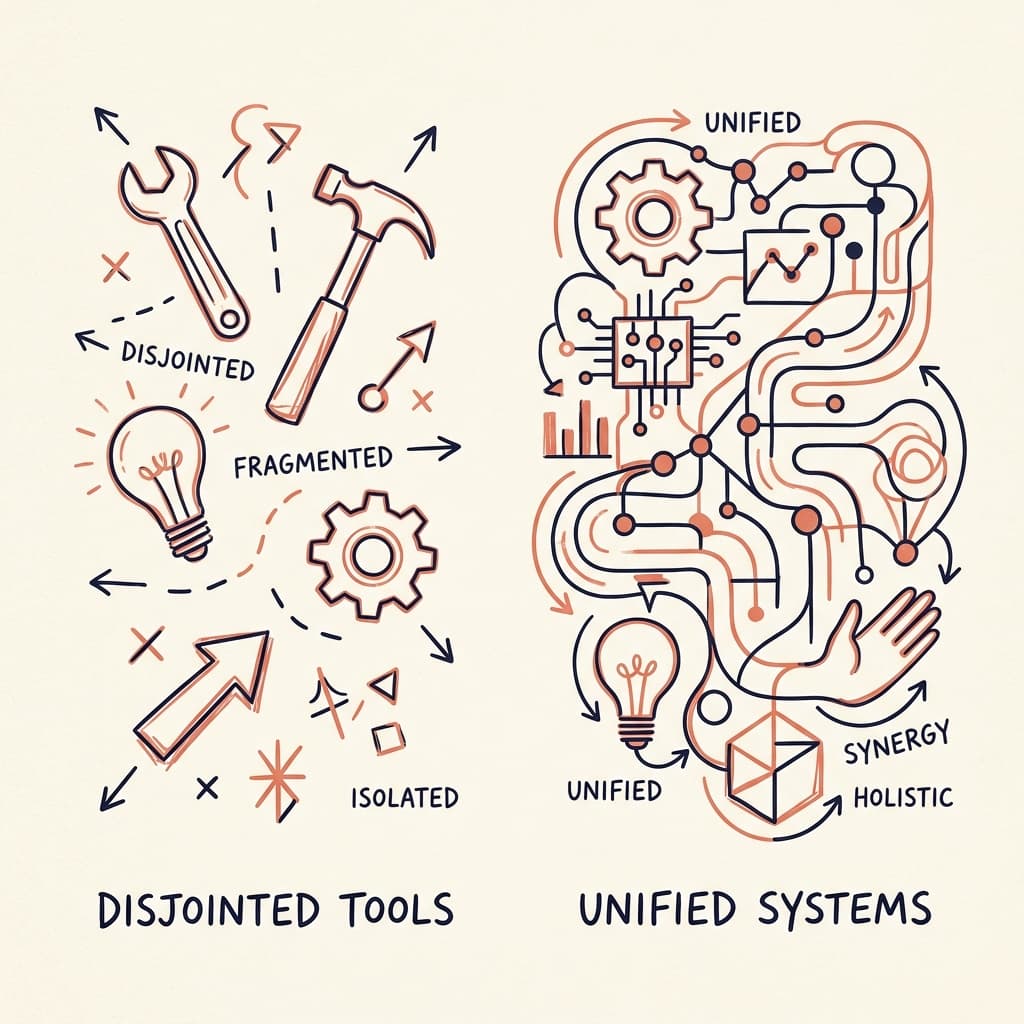
Stop Buying AI Tools, Start Building Systems
You are bleeding cash on subscriptions while your team spends more time managing software than executing work. The average enterprise now runs 367 SaaS tools [Source: BetterCloud, 2025]. Most marketing departments pay for five to twelve AI point solutions simultaneously. None of them share data. None of them learn from your business history. None of them eliminate the manual handoffs that are draining your team's time. The answer is not another subscription. The answer is a system.
Why Do Enterprise Teams Keep Buying AI Tools That Do Not Deliver Results?
The SaaS market is built to sell you micro-solutions. Vendors produce narrow tools because they are cheap to develop, easy to pitch, and generate predictable recurring revenue. When a tool solves 10% of your workflow problem, the vendor's answer is another tool for the next 10%. The result is a stack that grows every quarter while your operational efficiency flatlines.
65% of enterprise AI projects never reach production [Source: Gartner, 2025]. A significant share of that failure rate traces directly to tool fragmentation rather than AI capability limits. Teams spend more time moving data between platforms than they do extracting business value from any single platform.
The real cost of fragmentation is not the subscription line item. It is the cognitive overhead your team absorbs. Marketing professionals are hired for strategic thinking and creative judgment. Inside a fragmented stack, they function as human middleware -- translating outputs from one tool into inputs for another, and losing deep-work time to constant context-switching.
"The proliferation of point AI solutions has created a new class of technical debt. Organizations are not buying capability -- they are renting disconnected fragments that erode operational coherence over time." -- Dr. Sarah Ghosh, VP of AI Strategy, Forrester Research
What Does Software Fragmentation Actually Cost an Enterprise Organization?
Based on Seven Labs' experience scoping and delivering 50+ AI and automation engagements, the average marketing department loses 18 hours per employee per month to context-switching between applications alone. A team of 10 people burns 180 hours monthly on logins, data formatting, and file exports -- tasks that generate zero business value.
At a blended talent rate of $75 per hour, that is $13,500 per month spent moving data between tools rather than creating revenue.
The subscription fee is the cheapest part of a fragmented AI strategy. The full bill includes:
- 180 hours of monthly context-switching overhead for a 10-person team
- 3+ days of attribution analysis lost per campaign from broken UTM tracking across platforms
- 30% of potential campaign throughput eroded by manual handoffs between tools
- Growing regulatory risk from sensitive data scattered across dozens of external vendor environments
- Engineering hours spent building point-to-point integrations that break every time a vendor updates their API
When organizations stop buying AI tools and consolidate onto unified AI systems, the trajectory reverses. Seven Labs clients have documented 75% reductions in context-switching overhead and 40% increases in campaign throughput within 90 days of deploying a purpose-built AI platform.
"Companies that treated their internal operations as a product to be engineered -- not a stack to be assembled -- are the ones pulling away from competitors who are still evaluating tools." -- James Okafor, Principal Analyst, Technology Business Research
How Does a Custom AI System Compare to a Stack of Off-the-Shelf AI Tools?
| Factor | Off-the-Shelf AI Tools | Custom AI System |
|---|---|---|
| Setup time | Hours per tool, repeated across every new hire | One-time architecture build, onboarding in minutes |
| Data integration | Manual CSV exports and broken third-party APIs | Native integration with your CRM, analytics, and databases |
| Brand voice consistency | Per-tool configuration, inconsistent across platforms | Centralized prompt architecture enforces guidelines globally |
| Analytics visibility | Fragmented across 4-6 separate dashboards | Single pipeline from initial ideation to final conversion |
| Institutional learning | Resets with each session, no memory of past campaigns | Compounds from your historical performance data over time |
| Security and governance | Varies by vendor, often retrofitted | Role-based access and audit logs built into the architecture |
| Vendor lock-in | Dependent on 12 separate vendors and their pricing decisions | Modular, provider-agnostic architecture you own outright |
| Cost at scale | Stacks linearly with headcount and usage volume | Fixed infrastructure cost, usage scales without linear cost increase |
| Time to first output | Immediate for demo-level tasks | 18 days from concept to production [Seven Labs average] |
The table above reflects the architectural difference between renting someone else's workflow and engineering your own.
What Does the Before-and-After Look Like for a Real Marketing Team?
Before: The Four-Week Tool Treadmill
Week one: The team researches competitors in Tool A and pastes findings into a shared document that becomes stale the moment it is saved. Week two: A copywriter uses Tool B to generate drafts, ignoring the shared document because Tool B has incompatible character and formatting constraints. Week three: A designer builds assets in Tool C, which does not connect to Tool B. Version control collapses into email threads and Slack messages. A single typo found in a final render requires restarting the entire production process. Week four: The campaign launches late. Analytics are split between Tool D and Tool E. UTM parameters were lost during manual copy-paste. The team spends three full days in attribution debates with no resolution.
One campaign. Four weeks. Multiple points of failure baked into the process by design.
After: The Three-Day System Execution
Day one: A centralized system pulls live competitor data automatically through API connections. The same interface generates copy drafts anchored to your hard-coded brand voice guidelines and scored instantly against your historical campaign performance data. Day two: Designers and copywriters work inside the same environment. When a headline changes, the connected design file updates automatically. Approvals trigger the deployment sequence in a single action. Day three: The campaign launches. Performance data flows back into the creation environment in real time, flagging top-performing variants and generating three new creative variations from the winning structural components.
Four weeks compressed to three days. Zero manual handoffs. Zero data lost between steps. Zero attribution disputes.
What Is the Architecture of an AI System That Actually Works?
A unified AI system is not a single piece of software. It is a set of connected capabilities built around your specific operational data and business logic.
Centralized data ingestion pulls continuously from your CRM, analytics platforms, and customer support logs. The system's intelligence is grounded in your actual business data, not generic training patterns from the open internet.
Unified prompting architecture replaces individual users writing inconsistent prompts with centralized programmatic templates. When your brand voice guidelines change, you update one configuration file and the entire organization aligns immediately without retraining or re-briefing anyone.
Automated workflow handoffs eliminate the manual steps that cause delays and quality degradation. When a copywriter finishes a draft, the system automatically generates the design brief, notifies the creative team, and stages the asset for review without any human coordination required.
Closed-loop performance feedback means campaign results flow back into the system automatically. If an ad variant underperforms, the system logs the failure pattern, flags it, and adjusts future generation recommendations. The system compounds intelligence over time rather than resetting with every session.
Role-based access and governance are structural, not procedural. A junior marketer operates within guardrails that prevent publishing unapproved content. A director sees aggregate performance metrics and override controls. Compliance and security are enforced by the architecture itself.
These components are achievable today with existing technology. The obstacle is not capability. It is the default assumption that buying another tool is faster and safer than engineering a real system.
Why Is the Build-vs-Buy Decision Actually a Build-vs-Rent Decision?
The SaaS vendor's incentive model works against you. A vendor builds a narrow tool because a specific feature is easier to sell than a general capability. They want you to believe that an AI tool for writing email subject lines is fundamentally different from an AI tool for writing ad copy. The underlying model is the same. The only difference is the user interface and the monthly fee attached to it.
When you rent a vendor's workflow, you force your team to conform to the design decisions of a product manager you have never met. You have no access to the training methodology, no ability to tune the model's behavior to your data, and no control over when the vendor changes the output format or deprecates a feature.
When you build a system using custom AI development, you codify your company's operational advantage directly into software. Your customer behavior data, brand voice, and workflow logic become the engine. No off-the-shelf AI tool captures the specific patterns in your two years of campaign performance history. A system does. It learns from your specific wins and failures and applies that learning at machine speed.
The enterprises that compound their operational lead over the next decade will not have the most software subscriptions. They will have the most coherent, proprietary AI architecture.
What Questions Should You Ask Before Your Next AI Tool Purchase?
Before approving the next AI subscription, apply this four-question test:
- Does this tool write to a data store you own and control, or does your data live on the vendor's servers?
- Can this tool's output be consumed programmatically by your existing systems, or does a human have to copy it manually?
- Does this tool improve its recommendations based on your specific historical data, or does every session start from zero?
- If this vendor raises prices by 300% next year, what is your migration cost?
If any answer is unfavorable, you are not buying capability. You are renting a dependency.
Frequently Asked Questions
What is the difference between an AI tool and a custom AI system?
An AI tool solves one isolated problem -- writing subject lines, summarizing documents, or generating images in isolation. A custom AI system connects your data, workflows, and execution into a single unified pipeline. The system learns from your specific business history and compounds performance over time. Tools rent someone else's workflow. Systems encode your own competitive advantage.
How long does it take to build a unified AI system?
Based on Seven Labs' track record across 50+ AI and automation engagements, a well-scoped AI platform moves from concept to production in 18 days on average. Multi-department systems with complex data integration requirements typically take 60 to 90 days depending on compliance constraints and the number of existing data sources being connected.
Is custom AI development more expensive than buying off-the-shelf AI tools?
The upfront build cost is higher than a single subscription. The total cost comparison shifts quickly. A 10-person team losing 18 hours monthly per person to context-switching burns $13,500 per month in hidden productivity cost alone. A unified system eliminates that overhead while compounding value with every campaign. Most Seven Labs clients recover their build investment within two to three quarters.
Do you need to replace your entire existing stack to build a unified AI system?
No. A well-designed AI platform integrates with your existing infrastructure through APIs and data connectors. The goal is not to eliminate every tool you currently use. The goal is to build an orchestration layer that eliminates manual handoffs, creates a single source of truth, and allows your existing data and tools to work together without human coordination at every step.
Ready to stop buying tools and start building a system that compounds operational advantage? Seven Labs builds AI platforms that eliminate fragmentation and deliver measurable throughput improvements from day one. Start with our AI platforms service or contact us directly to scope your build.